Executive summary
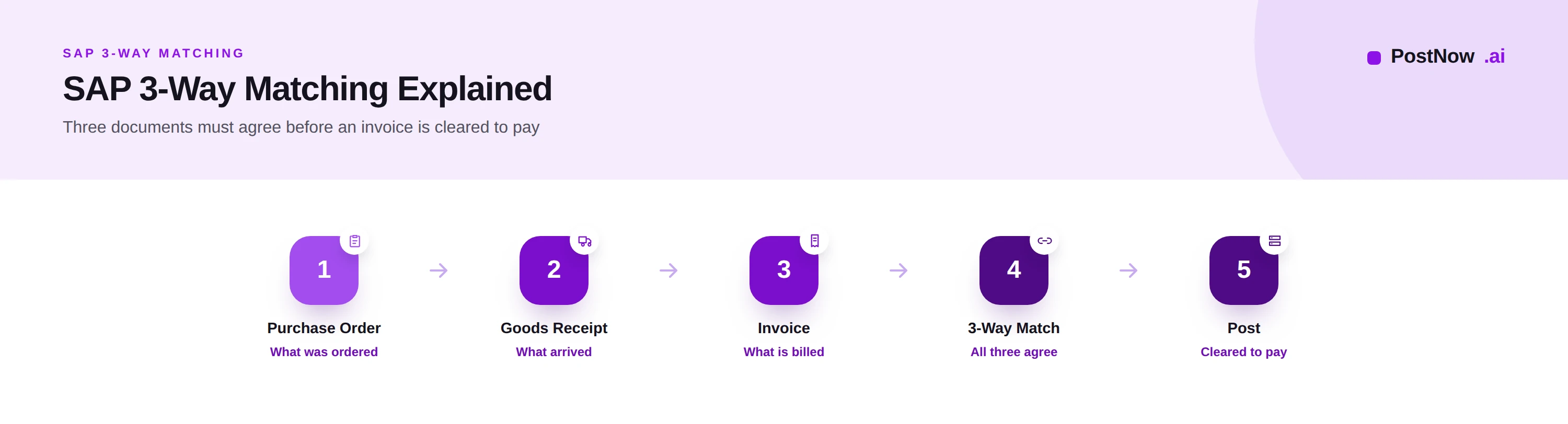
Three-way matching is the accounts payable check that compares three documents, the purchase order, the goods receipt, and the supplier invoice, and clears an invoice for payment only when all three tell a consistent story.
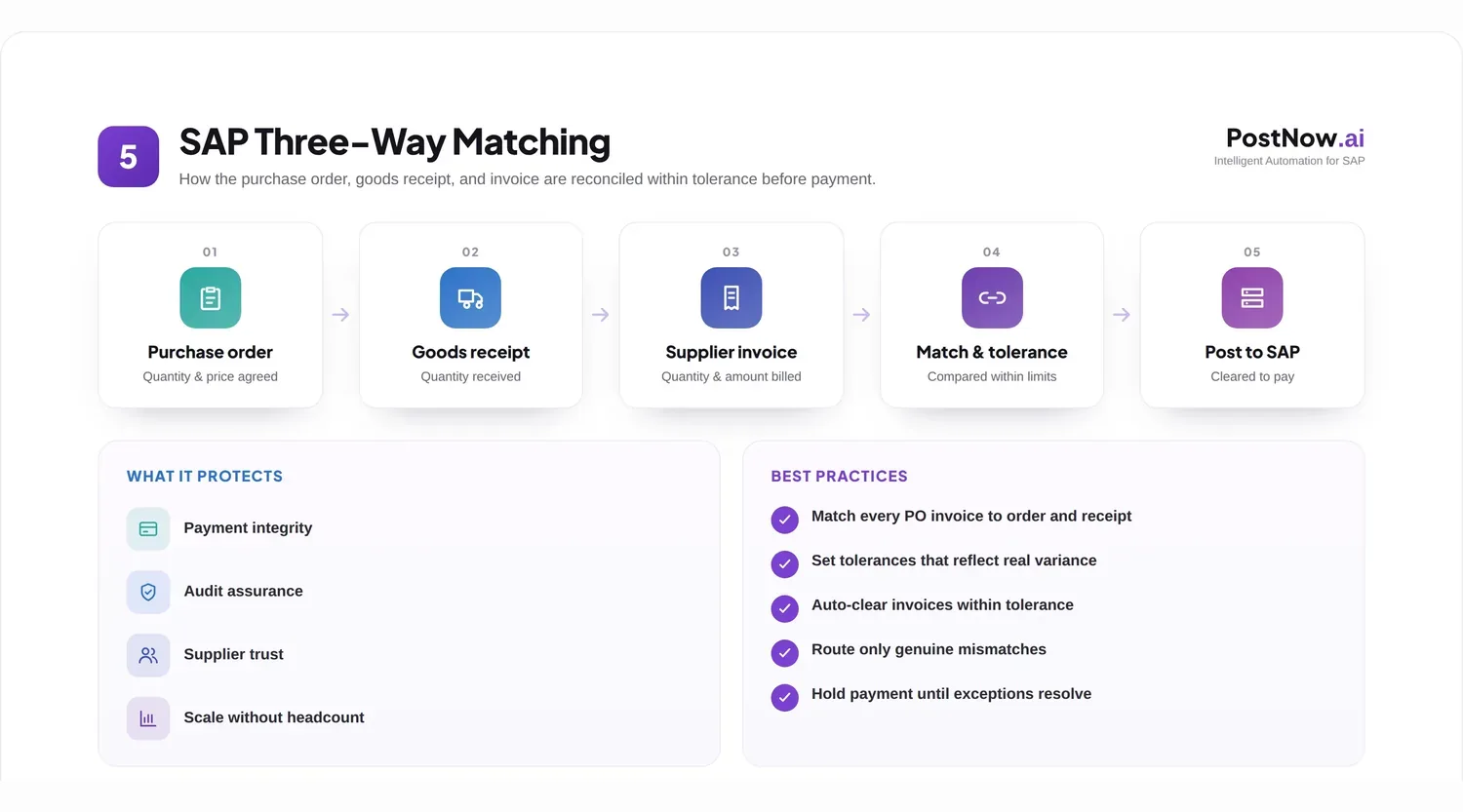
It exists to answer one disciplined question before money leaves the business: did we order this, did we receive it, and is this what we agreed to pay. When the answer to all three is yes, payment is safe. When it is not, the invoice is held until the difference is understood.
This article explains three-way matching in detail: the three documents and what each proves, how the comparison runs with a worked example, the role of tolerances, how mismatches are handled, and how the check is automated. It pairs with the broader SAP invoice matching solution and the invoice management pillar.
What is three-way matching?
Three-way matching is a verification that an invoice agrees with both the order that authorized the purchase and the receipt that confirmed delivery, before that invoice is posted and paid.
The number in the name refers to the three documents involved. A two-way check would compare only the invoice and the order; the third document, the goods receipt, is what makes the match a three-way one and what gives it its strength. By adding proof of delivery, three-way matching closes the loophole through which an organization could pay for goods that were ordered and billed but never actually arrived.
In an SAP landscape this check is performed during logistics invoice verification, where the invoice is brought together with its order and receipt. It is the standard control for invoices that relate to physical goods, precisely because, for goods, the question of whether they were received is both meaningful and material.
Put plainly, three-way matching is the mechanism that keeps a purchase honest from end to end: what was promised, what was delivered, and what is billed must all line up.
The three documents
Each of the three documents proves something different, and the match is the act of confirming they agree.
The purchase order is the record of intent. It states what the organization committed to buy, in what quantity, and at what price, at the moment the commitment was made. It is the agreed truth against which the rest is judged, and without it there is nothing to match an invoice to.
The goods receipt is the record of fulfilment. It is created when goods arrive and confirms what was actually delivered, in what quantity, and when. It is the evidence that the purchase order's promise was kept, and it is the document that two-way matching lacks.
The invoice is the claim for payment. It is the supplier's statement of what it believes it is owed, for what, and how much. It is the document under examination, and the purpose of the match is to decide whether its claim is justified by the order and the receipt.
Seen together, the three answer three separate questions, did we agree to this, did we get it, and is the bill consistent with both. Only when the answers align does the invoice deserve to be paid, and three-way matching is simply the structured way of confirming that alignment.
How the check works
The mechanics are a comparison across the three documents, line by line, on the dimensions that matter: quantity and price.
Once an invoice is linked to its purchase order, the check confirms two things. On quantity, the amount billed should not exceed the amount received, which the goods receipt records, nor the amount ordered, which the purchase order records. On price, the rate billed should agree with the rate on the order. When both hold for every line, the invoice is consistent with what was agreed and delivered.
A worked example makes this concrete. Suppose an order is placed for five hundred boxes of a component at a fixed price per box. Over time, deliveries arrive and goods receipts record four hundred and eighty boxes actually received. The supplier then submits an invoice for all five hundred boxes at the agreed price. The price axis matches the order, so a two-way check would see nothing wrong. The three-way check, however, compares the invoiced five hundred against the four hundred and eighty receipted, and holds the invoice for the twenty boxes that were billed but not yet received. The organization pays for what arrived, not for what was merely promised.
That example captures the essence of the control. The order and the price agreeing is not enough; delivery must be proven too, and it is the goods receipt that supplies the missing proof.
SAP performs the three-way match natively, so for most teams the question is not whether the ERP supports it but how the documents get in. Purchase orders, goods receipts and invoices all have to be created first, and at volume that is usually the bottleneck rather than the match itself. PostNow creates those documents in SAP ECC and S/4HANA from Excel, covering ME21N for purchase orders, MIGO for goods receipts and MIRO for invoice receipts, using standard BAPIs with field validation before each write.
Tolerance rules
Insisting on exact agreement to the last unit and the smallest fraction would stall the process, so the check allows defined, acceptable differences.
Real purchasing produces small, legitimate variances. A price may move slightly between order and invoice, a delivery may round to a convenient quantity, and rounding itself creates minor differences. Tolerances define how much of such variance is acceptable, so that an invoice differing only trivially still clears automatically.
In practice, separate tolerances govern price and quantity. A price difference within the permitted band passes; one beyond it is held. A quantity difference within its band passes; one beyond it is held. The bands can be expressed as a fixed amount, a proportion, or both, and they reflect the organization's judgement about what size of difference warrants a human look.
Calibrating tolerances is a balance worth revisiting. Set too narrow, and the team is buried in immaterial holds; set too wide, and genuine errors slip through unexamined. The right setting lets the routine pass and ensures the material is always caught, and it is refined as the organization learns where real differences actually arise.
Handling mismatches
When the three documents do not agree within tolerance, the invoice becomes a mismatch that must be resolved before it can be paid.
Mismatches take a few characteristic forms. A quantity mismatch arises when the invoice bills more than was received, as in the worked example. A price mismatch arises when the billed rate exceeds the order rate beyond tolerance. A missing receipt prevents the delivery axis from being confirmed at all. And occasionally an invoice bills for items not on the order whatsoever.
Each has a typical resolution. A quantity mismatch often waits for an outstanding goods receipt to be posted, after which it may clear on its own. A price mismatch usually needs a buyer to confirm whether a new price was agreed, in which case the order is corrected, or whether the supplier has overbilled, in which case it is disputed. A missing receipt is chased with the receiving function. An unauthorized charge is queried with the supplier.
The lasting improvement comes from looking past the individual mismatch to its cause. Repeated quantity holds may point to a receipting delay; repeated price holds, to orders that are not kept current. Correcting those causes removes whole categories of mismatch, which is far more valuable than resolving each occurrence as it appears.
Automating three-way matching
Performed manually, the check means a person comparing three documents for every invoice. Automated, it happens instantly and silently for the invoices that agree.
An automated check links each invoice to its order, compares quantities against the receipt and the order and prices against the order, applies the tolerances, and decides whether to clear the invoice or hold it. For the large share of invoices that are consistent, this completes in moments with no human involvement, which is what allows an accounts payable function to process high volume without a proportional team.
Automation also sharpens how mismatches are handled. By identifying the axis and size of each difference, it presents the exception already characterized, so the person resolving it begins with the facts rather than a comparison. Over time, the record of mismatches reveals the patterns that point to upstream causes worth fixing.
The quality of automated matching rests on its inputs: accurate reading of the invoice, a clean order reference, and a timely goods receipt. Where those are sound, the proportion of invoices clearing automatically is high; where they are weak, holds multiply regardless of the tool. The surrounding capabilities are covered under accounts payable automation and Document AI.
Why organizations use it
Three-way matching is widely adopted because it protects cash and provides assurance at a modest cost, especially once automated.
It prevents improper payment. By requiring proof of delivery, it stops the organization from paying for goods that did not arrive, which is its primary purpose and its clearest return.
It provides audit assurance. A completed three-way match is evidence that a payment was justified by an order and a receipt, which controllers and auditors rely on. The match record explains, for any payment, why it was made.
It supports good supplier relationships. Paying correctly for what was received, and raising genuine differences clearly, is fairer to suppliers than paying late or short without explanation, and it reduces disputes.
It scales when automated. Once the check runs automatically, its protection extends across every qualifying invoice at little marginal cost, so control improves as volume grows rather than straining under it.
The case for three-way matching, in short, is that it converts a simple discipline, prove the order, the receipt, and the bill agree, into a dependable, scalable safeguard over the organization's cash.
Frequently asked questions
What is three-way matching in SAP?
What are the three documents in three-way matching?
What is the difference between two-way and three-way matching?
How does three-way matching prevent overpayment?
What are tolerance limits in three-way matching?
What happens when three-way matching fails?
Is three-way matching required for all invoices?
How is three-way matching automated?
Conclusion
Three-way matching is a small discipline with a large payoff: by confirming that the order, the receipt, and the invoice agree, it keeps a purchase honest from commitment to payment.
The order proves agreement, the goods receipt proves delivery, and the invoice makes the claim; the match is the act of confirming they align, within sensible tolerances, before money moves. Mismatches are held and resolved, and the greatest value comes from removing their causes rather than merely processing them. Automated, the check protects every qualifying invoice at little marginal cost.
For the broader matching capability and its place in the pay process, see SAP invoice matching, accounts payable automation, and the invoice management pillar.