Executive summary
Supplier onboarding automation is the practice of bringing a new vendor into an organization, collecting their details, verifying them, securing the right approvals, and creating a governed record in SAP, through an automated workflow rather than email threads and manual data entry.
Onboarding is the front door to the supplier relationship and to a great deal of risk. The data captured here, a vendor's legal identity, tax status, and bank details, flows into every future payment. A mistake or a fraud at onboarding does not stay contained; it propagates into the payment run. Automating onboarding is therefore as much about control and risk as it is about speed.
This page explains how to automate supplier onboarding in an SAP environment. It covers what the process is, why it matters, how the lifecycle runs, the components that make it reliable, the documents involved, the governance and risk controls it must enforce, a maturity framework, and the future of the discipline.
Onboarding sits alongside ongoing vendor master automation, which maintains the record after creation, and draws on the document-reading capability of SAP Document AI.
What is supplier onboarding automation?
Supplier onboarding automation is the automated handling of vendor registration, verification, approval, and creation, producing a complete, validated, governed vendor master record in SAP.
In a manual process, a new supplier is added through scattered emails, a registration form, attached documents, and a clerk keying the result into SAP. Automation replaces this with a structured intake: the supplier provides their information through a controlled channel, the system reads and verifies it, the right people approve it, and the vendor record is created and governed, all tracked end to end.
The terms around this overlap. Supplier onboarding automation and vendor onboarding automation describe the same thing, the automated intake of a new supplier. SAP vendor onboarding emphasizes that the destination is an SAP vendor record, with its specific fields and, in S/4HANA, its Business Partner structure. Vendor master automation is the broader and ongoing discipline of creating and maintaining vendor data, of which onboarding is the entry point.
Done well, onboarding produces a vendor that is correct, verified, and ready to transact from the first invoice, rather than one that generates payment problems and clean-up work later.
Why supplier onboarding automation matters
Onboarding shapes the quality and safety of every transaction that follows, which is why automating it returns far more than the time it saves.
Risk reduction. The largest risk in accounts payable is paying the wrong party. Verifying a supplier's identity and bank details at onboarding is the primary defense against payment fraud, and automation applies that verification to every vendor without exception.
Data quality. Clean, validated creation prevents the duplicate and inaccurate vendor records that distort spend analysis and cause payment errors. Quality established at onboarding is far cheaper than quality retrofitted later.
Speed and supplier experience. A fast, clear onboarding lets a supplier begin transacting sooner and signals a well-run organization, where a slow, confusing one frustrates suppliers before the relationship has begun.
Governance and compliance. Onboarding must enforce tax collection, sanctions and risk screening, and approval policy. Automation applies these consistently and records them, satisfying both internal control and external regulation.
Scalability. A growing or acquisitive business onboards many suppliers. One automated process handles that volume and extends across entities and regions, where a manual one simply needs more people.
How supplier onboarding automation works
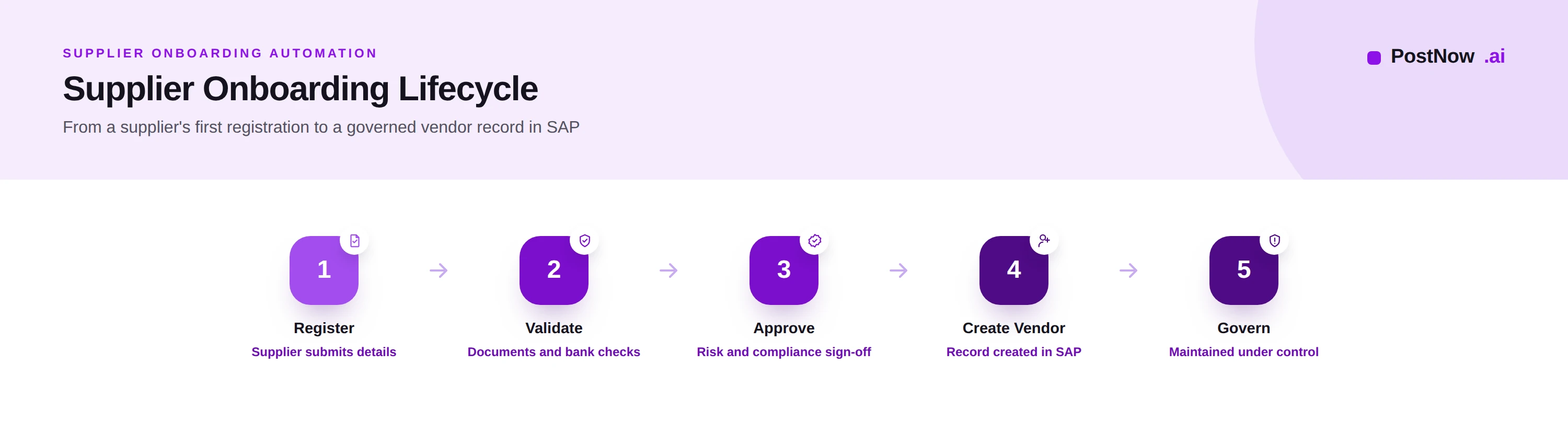
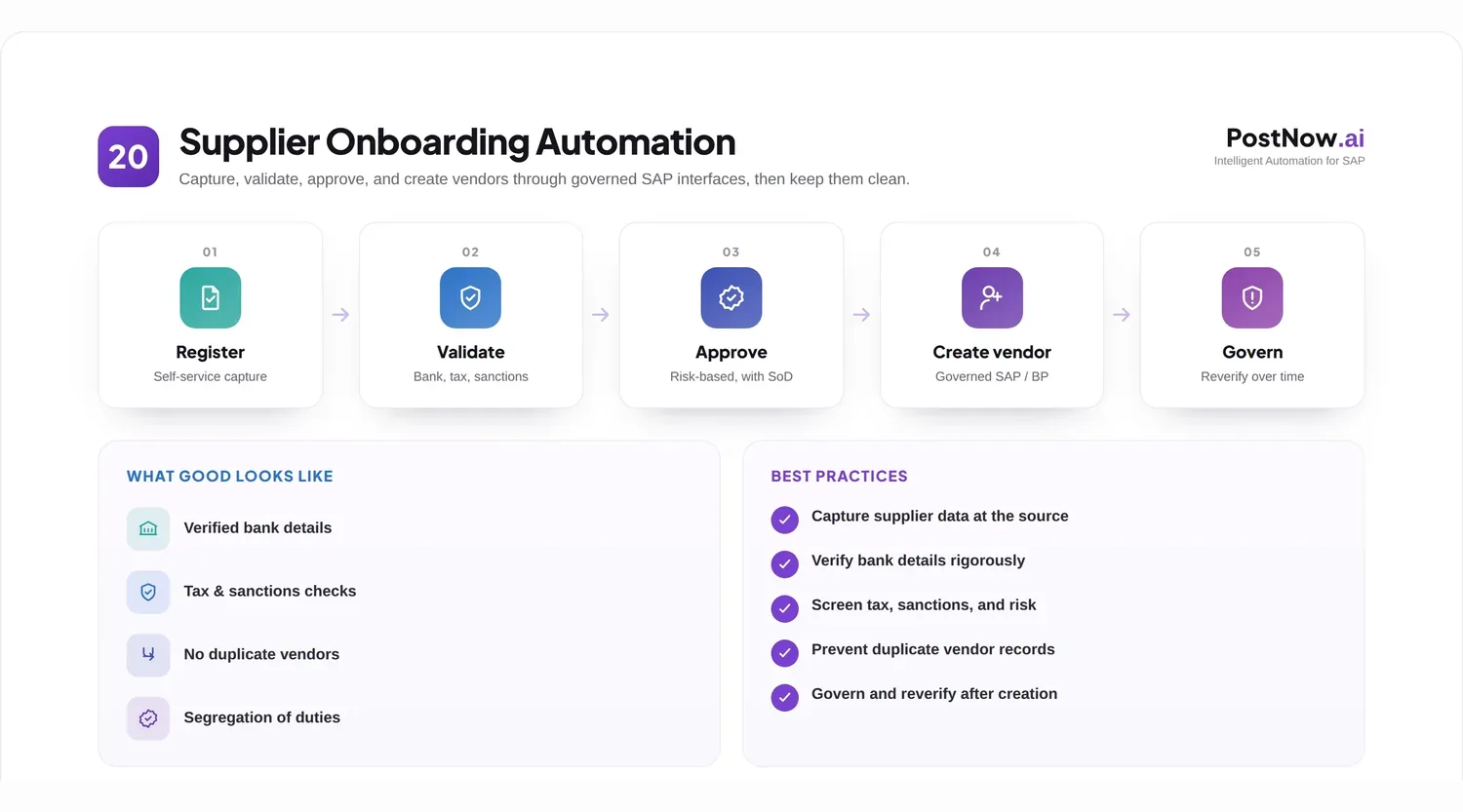
The lifecycle moves a prospective supplier from first contact to a live, governed vendor record through five stages.
Register. The supplier provides their information through a controlled channel, such as a registration portal or a structured form, supplying their legal details, tax identifiers, and supporting documents. Capturing this at the source, from the supplier, is more accurate than re-keying it internally.
Validate. The submitted information is verified: the documents are read, the tax identifier is checked, the bank details are confirmed, and the supplier is screened against risk and sanctions lists. Validation is where onboarding earns its place as a control.
Approve. The verified supplier is routed for the approvals policy requires, which may include procurement, finance, and compliance, with the level of scrutiny matched to the supplier's risk and category.
Create vendor. Once approved, the vendor master record is created in SAP, complete and correct, ready to receive purchase orders and invoices, respecting the relevant structure such as the Business Partner model in S/4HANA.
Govern. After creation, the record enters ongoing governance: changes are controlled, periodic reverification occurs, and the record stays accurate over its life. Onboarding does not end at creation; it hands over to stewardship.
A straightforward, low-risk supplier can pass through this lifecycle quickly and largely automatically, while a higher-risk one receives the additional scrutiny its profile warrants.
Core components
Several components combine to make onboarding both fast and safe.
A registration channel collects supplier data at the source in a structured way, reducing the errors that re-keying introduces and giving the supplier a clear, single place to provide what is needed.
Document processing reads the registration and tax forms, bank letters, and certificates the supplier submits, extracting their data automatically rather than leaving a clerk to transcribe them.
Verification services confirm the supplier is real and as claimed: validating the tax identifier, confirming the bank account, and screening against sanctions and risk sources.
A workflow engine routes approvals by risk and category, applies escalation, and keeps each supplier moving toward a decision.
SAP creation integration writes the approved vendor into the master through governed interfaces, applying the structure and validations the system requires.
Governance and audit control subsequent changes, schedule reverification, and record every step, so the record stays trustworthy and the process stays defensible.
These components are interdependent. Strong capture improves verification, strong verification reduces the risk approval must catch, and strong governance preserves the quality that onboarding established.
Vendor documents and bank validation
Onboarding is document-heavy, and one verification matters above the rest.
Registration forms carry the supplier's legal name, addresses, and contacts. Reading them accurately establishes the basic identity of the vendor.
Tax forms, such as a W-9 in the United States or its equivalents elsewhere, capture the tax identifier and status required for compliant payment and reporting. Automation reads and validates these so the tax position is correct from the start.
Bank documents, such as account confirmation letters, provide the details money will be sent to, and verifying them is the single most important safeguard in onboarding. Confirming that the bank account genuinely belongs to the supplier, rather than to a fraudster who has intercepted the process, prevents the most damaging form of payment fraud.
Certificates and compliance documents, such as insurance or industry credentials, are captured and checked where the supplier category requires them.
Reading these documents is where the Document AI capability applies directly: it classifies each document, extracts its data regardless of format, and feeds verification, so onboarding does not stall on manual transcription.
Governance, risk, and data quality
Onboarding is where governance and risk management are most consequential, because everything downstream inherits the record it creates.
Risk management begins at intake. Screening suppliers against sanctions and risk lists, and matching scrutiny to category and spend, keeps the organization from transacting with parties it should not, and concentrates effort where exposure is greatest.
Data quality is set here for the life of the record. Preventing duplicates at creation, by checking whether a supplier already exists, and enforcing complete, consistent data, avoids the fragmented vendor master that undermines spend analysis and payment. This discipline aligns with master data governance and master data management.
Segregation of duties ensures the person who registers or approves a supplier is not the one who pays it, removing a primary avenue for fraud. Automation enforces this through roles rather than relying on memory.
Audit and accountability record who verified, approved, and created each vendor, so the organization can show, at any time, that a supplier was brought on properly.
The principle is that a vendor should not be payable until it has been verified, approved, and created under control. Automation makes that the default rather than the aspiration.
Best practices
These practices separate onboarding that protects the organization from onboarding that merely speeds data entry.
- Capture supplier data at the source through a registration channel rather than re-keying it.
- Verify bank details rigorously, treating account confirmation as the central anti-fraud control.
- Validate tax identifiers and status so payment and reporting are compliant from the first invoice.
- Screen against sanctions and risk lists before any supplier becomes payable.
- Check for existing records to prevent duplicate vendors at creation.
- Match scrutiny to risk and category, reserving deep review for higher-exposure suppliers.
- Enforce segregation of duties so registration, approval, and payment are separated.
- Read documents automatically rather than transcribing forms manually.
- Create vendors through governed SAP interfaces with full validation.
- Respect the target structure, including the Business Partner model in S/4HANA.
- Govern changes after creation, controlling who can amend a vendor record.
- Reverify periodically, so details such as bank accounts stay current and trusted.
- Record every step, producing an audit trail of verification, approval, and creation.
- Give suppliers a clear experience, since a smooth intake reflects on the whole relationship.
- Measure onboarding time and quality, and improve the slowest, most error-prone steps.
In practice, the suppliers an organization onboards vary widely, from a one-off low-value vendor to a strategic partner carrying significant risk, and a mature process flexes to treat each appropriately rather than forcing all of them through the same heavy intake.
Common challenges
Onboarding automation meets a recognizable set of obstacles, each with a practical response.
Incomplete supplier submissions. Suppliers omit required fields or documents. Mitigate by validating at the point of submission and guiding the supplier to complete what is missing before the request proceeds.
Fraud attempts. Bad actors impersonate suppliers or redirect bank details. Mitigate with rigorous bank verification, independent confirmation, and segregation of duties so no single person can create and pay a vendor.
Duplicate vendors. The same supplier is onboarded more than once. Mitigate by checking for existing records at creation and governing the master to prevent fragmentation.
Slow approvals. Onboarding stalls waiting for sign-off. Mitigate with automated routing, escalation, and risk-based scrutiny so straightforward suppliers are not held up by the process built for risky ones.
Integration and structure. Creating a vendor correctly in SAP, especially under the Business Partner model, takes care. Mitigate by governing the integration and validating the record against SAP requirements before creation.
The PostNow supplier onboarding maturity framework
Onboarding maturity is measured by how much of the intake is automated and how consistently risk is controlled. This framework describes five levels.
Level 1, manual. Suppliers are onboarded through email and manual keying, with verification ad hoc and inconsistent.
Level 2, form-based. A structured form standardizes intake, but verification and creation remain largely manual.
Level 3, validated. Key checks, tax, bank, and screening, are applied consistently, and approvals are routed by workflow.
Level 4, intelligent. Documents are read automatically, verification is largely automated, and only exceptions and higher-risk suppliers need manual attention.
Level 5, governed and autonomous. Low-risk suppliers onboard with little human touch, risk is continuously screened, and the vendor record is governed throughout its life, with people focused on judgement and exceptions.
| Level | Intake | Verification | Human focus |
|---|---|---|---|
| 1 Manual | Email and keying | Ad hoc | Everything |
| 2 Form-based | Structured form | Manual | Verify and create |
| 3 Validated | Form plus checks | Consistent | Approvals |
| 4 Intelligent | Read automatically | Largely automated | Higher-risk cases |
| 5 Governed | Low-touch | Continuous | Judgement and exceptions |
Most organizations sit between levels two and four. The framework helps locate the current level and choose the next investment in capture, verification, or governance.
The future of supplier onboarding
Onboarding is moving toward continuous, intelligent supplier management rather than a one-time intake event.
AI reads supplier documents of any format and assesses risk with less manual effort, while intelligent workflows adapt the depth of onboarding to each supplier's profile. Continuous verification shifts checking from a single moment to an ongoing assurance, reverifying bank and risk status over the relationship rather than only at the start.
Autonomous onboarding is the direction this implies: routine, low-risk suppliers onboarded with minimal human touch, and people concentrating on the higher-risk and exceptional cases. As with the rest of finance automation, accountability remains human; the system accelerates and screens, while people own the decision to trust and transact with a supplier.
Frequently asked questions
What is supplier onboarding automation?
How does vendor onboarding work in SAP?
Why is bank account verification important in onboarding?
What documents are processed during supplier onboarding?
How does onboarding automation prevent duplicate vendors?
What is the difference between onboarding and vendor master automation?
How is supplier risk managed during onboarding?
Can onboarding automation work with SAP S/4HANA?
Conclusion and next steps
Supplier onboarding automation turns the front door of the supplier relationship into a fast, controlled, and auditable process, protecting the organization from fraud and poor data while giving suppliers a smooth start.
The lifecycle is consistent: register at the source, verify rigorously with bank confirmation at its center, approve by risk, create under governance, and steward the record thereafter. The destination is largely autonomous onboarding for routine suppliers, with people focused on risk and judgement.
A practical first step is to put a structured registration channel in place and automate bank and tax verification, then extend to document reading and risk-based approval. To go further, see vendor master automation, Document AI, and accounts payable automation.