Introduction
AI is starting to change how SAP data work gets done, taking on parts of mapping, validation, and anomaly detection that once fell entirely to people. The promise is real, but so is the need for a clear head about what it can and cannot do.
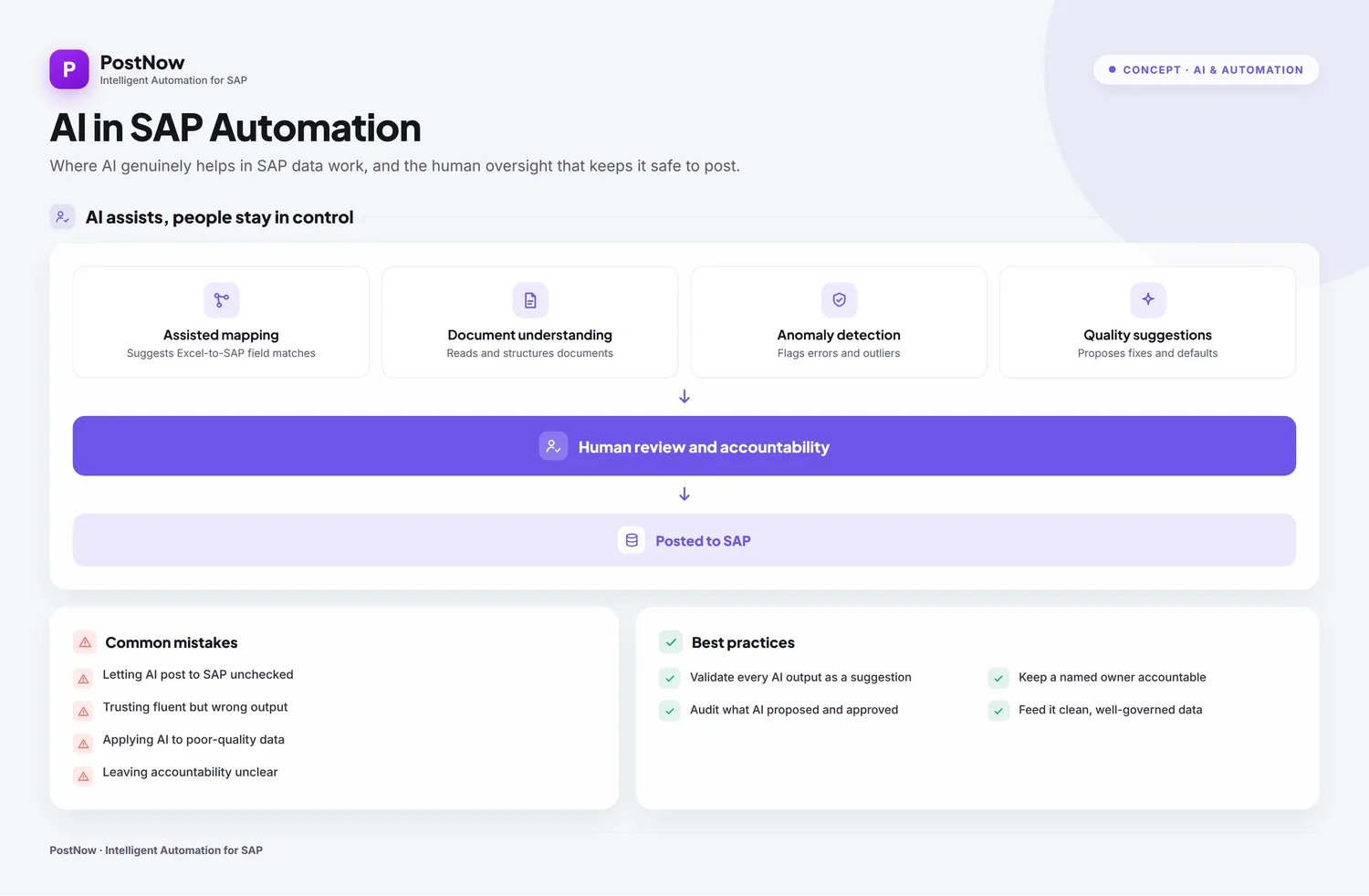
The topic arrives with a great deal of noise. Vendors promise transformation, headlines promise disruption, and it can be hard to separate genuine capability from marketing. The useful question is not whether AI is exciting but where, specifically, it earns its place in SAP automation today.
This guide takes that practical view. It looks at where AI genuinely helps, where human oversight remains essential, and how to use it safely with proper guardrails. It builds on the SAP process automation pillar and the data quality best practices guide.
It is written for SAP teams who want to adopt AI thoughtfully, capturing the benefits without inheriting avoidable risks.
A note on tone before we begin. This guide deliberately avoids both extremes, the breathless enthusiasm that oversells AI and the reflexive skepticism that dismisses it. The honest position is in between: AI is a capable new tool with a specific shape of strength and weakness, and using it well means knowing that shape.
It is also worth separating AI the capability from AI the marketing term. Many features now labelled as AI are useful regardless of the label, and a few are little more than rebranding. Judging each feature by what it actually does, rather than by what it is called, cuts through most of the confusion.
Why this matters
AI in SAP is neither magic nor a gimmick. Treated as either, it disappoints; treated as a capable assistant with limits, it adds real value.
The business impact is genuine where the fit is right. AI can take on tedious, pattern-heavy work such as proposing mappings or spotting unusual values, freeing people for the judgment that machines handle poorly. Used well, it makes existing automation more capable rather than replacing the discipline around it.
The governance stakes are equally genuine. An AI suggestion that posts to SAP without review is an unaccountable change, and an AI that cannot explain itself is hard to audit. Adopting AI responsibly means deciding, in advance, where it may act and where a person must approve.
The operational reality sits between the extremes. AI today is a strong assistant and a poor autonomous authority for consequential SAP actions, so the value comes from pairing its speed with human oversight rather than from removing the human entirely.
It also helps to be specific about what kind of AI is in question. In SAP automation the relevant systems are mostly those that recognize patterns, read text, and make suggestions, rather than anything resembling independent reasoning. Keeping expectations matched to that reality is the surest way to avoid disappointment.
Throughout, the assumption is that AI operates inside a disciplined automation practice, not as a substitute for one. AI applied to a messy, ungoverned process tends to make the mess faster, whereas AI applied to a clean, well-run one makes a good process better. The foundation matters more than the feature.
The structure ahead moves from why AI matters, through where it concretely helps, to the limits and guardrails that keep it safe, before the practical challenges, practices, and mistakes. Readers short on time can jump to the opportunities-and-limits table for the heart of the realistic case.
Core concepts: where AI helps in SAP
Stripped of hype, AI in SAP automation shows up in a handful of concrete, useful applications.
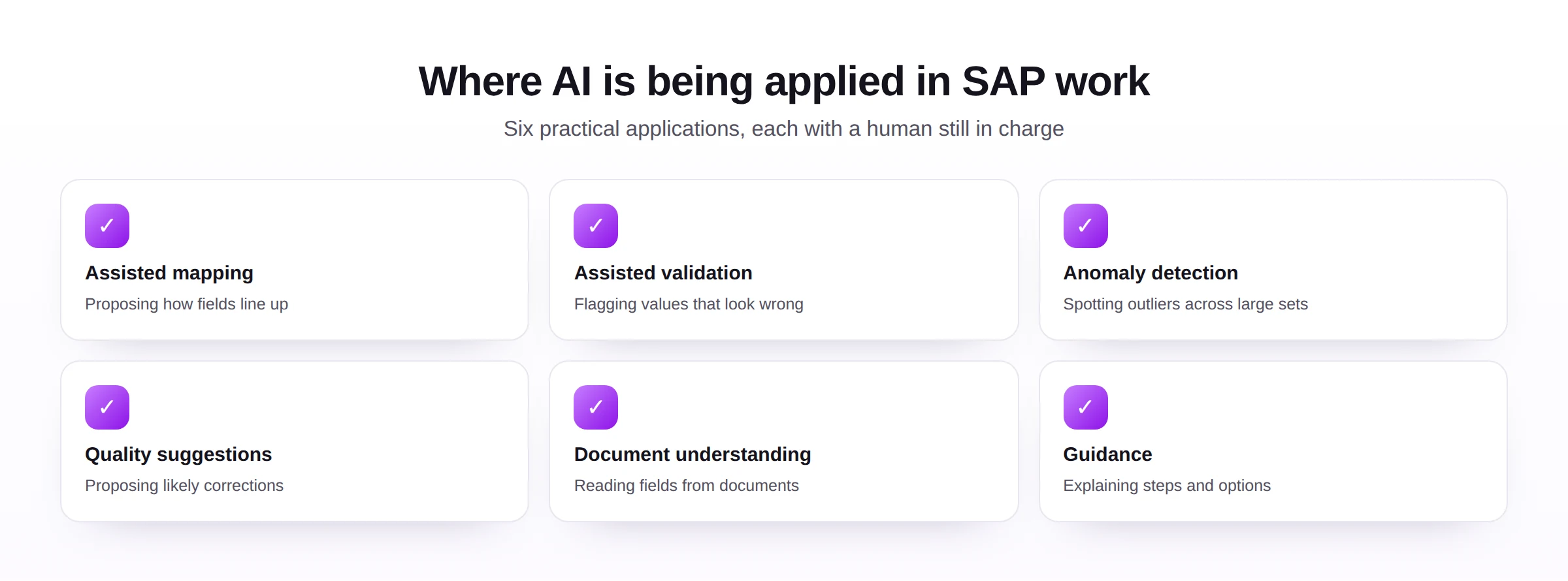
What unites these applications is that each takes a task that is laborious for a person but patternable for a machine, and hands the laborious part to the machine. None of them removes the need for judgment; they remove the drudgery that used to surround it, which is a meaningful and realistic kind of help.
Assisted mapping proposes how source fields line up with SAP fields, turning a slow manual task into a review of sensible suggestions. Assisted validation flags values that look wrong, adding a layer of pattern-based judgment on top of fixed rules.
Anomaly detection surfaces outliers across large data sets that a person would struggle to scan, and quality suggestions propose likely corrections for a steward to approve. Both lean on solid master data management to be useful.
Document understanding reads fields from documents such as invoices, and guidance explains steps or options in plain language. In every one of these, the pattern is the same: AI proposes, accelerates, or flags, and a person decides.
It is worth noticing what is absent from this list: anything where AI is left to decide alone. That omission is intentional. The applications where AI adds value today are precisely those where a person remains the final authority, and that is likely to stay true for consequential SAP actions for some time.
Opportunities, limits, and guardrails
A realistic view holds two truths at once: AI genuinely helps in specific areas, and people remain essential in others.
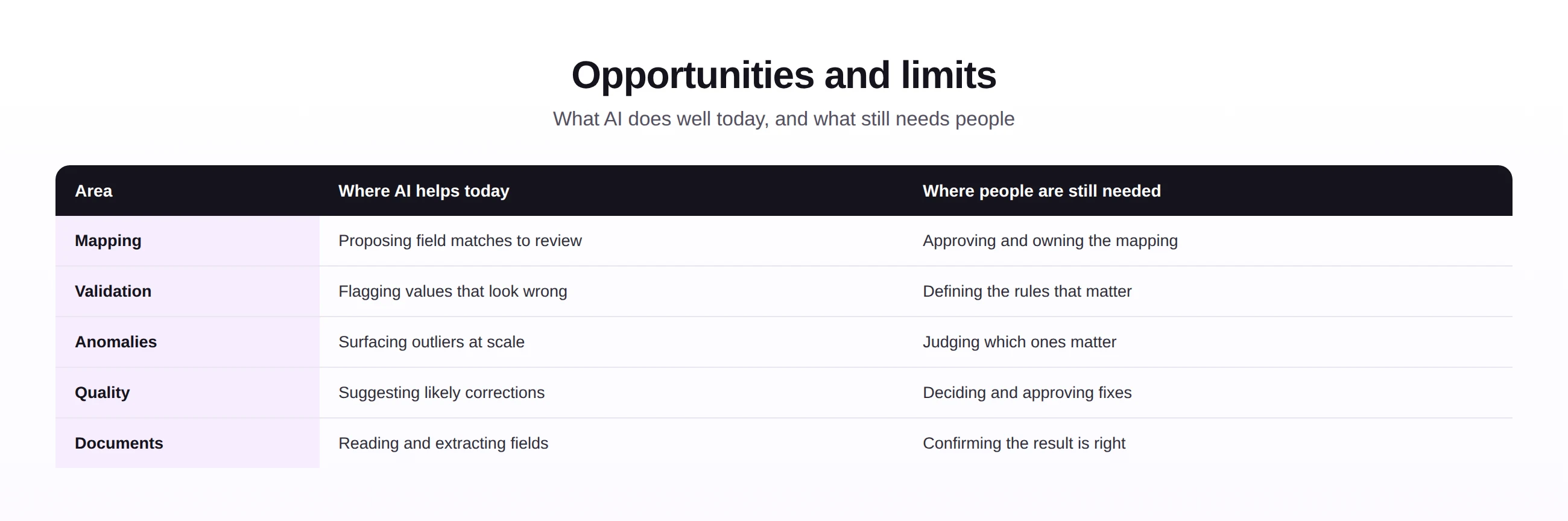
Reading the table honestly is itself a useful discipline. The left column is genuinely encouraging, and it is tempting to dwell there; the right column is the part that protects you, and it is the part most easily forgotten in a demonstration. Both columns are equally real.
The pattern across the table is consistent. AI is strong at proposing, surfacing, and reading at scale, and weaker at owning, deciding, and being accountable. The dividing line is responsibility: AI can do the legwork, but a person must own the consequential choice.
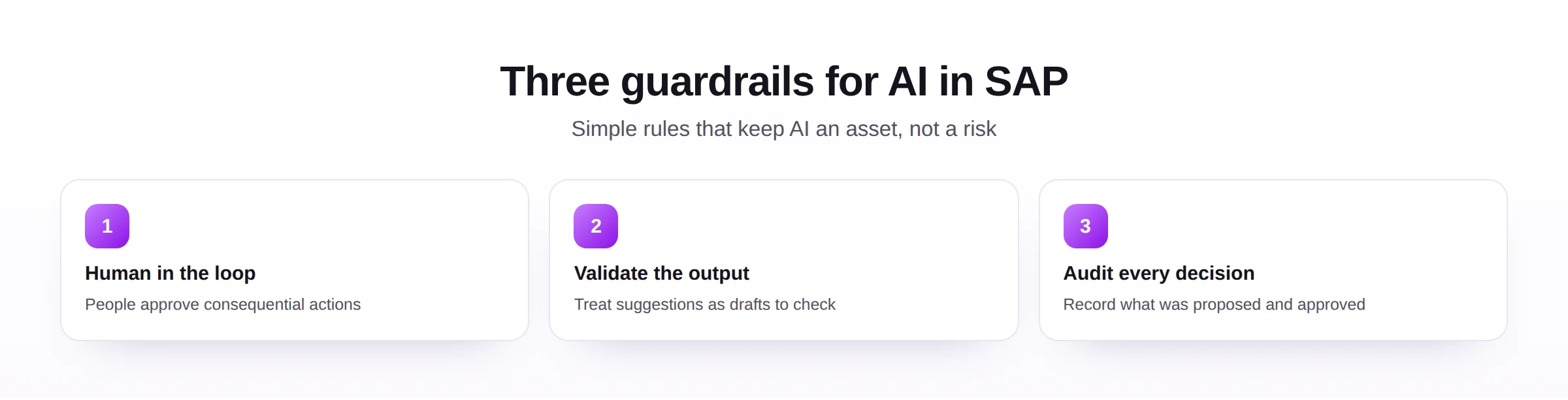
Three guardrails make this safe in practice. Keep a human in the loop for consequential actions, treat every AI output as a draft to validate rather than a fact to trust, and audit each decision so what AI proposed and who approved it is on record. With these in place, AI accelerates work without quietly taking responsibility it cannot hold.
None of these guardrails is exotic, and that is the point. They are the same controls any sensible organization would place around a fast but fallible new contributor: check the work, keep someone accountable, and write down what happened. Applied to AI, they turn an uncertain tool into a trustworthy one.
Common challenges
Adopting AI in SAP raises a few genuine challenges that deserve honest treatment rather than dismissal.
- Confident errors, where AI offers a wrong answer as plausibly as a right one, which is why validation matters.
- Limited explainability, where a suggestion is hard to justify, complicating audit and trust.
- Data dependence, since AI trained or prompted on poor data inherits its flaws.
- Accountability gaps, where it is unclear who owns an AI-driven action that goes wrong.
- Over-trust, where speed and fluency tempt people to skip the review the output still needs.
The root cause of most difficulty is treating AI as an authority rather than an assistant. Once it is framed as a fast helper whose work is checked, each of these challenges becomes a manageable matter of process rather than a reason to avoid the technology.
It is worth dwelling on the over-trust challenge, because it is the most human and the hardest to police. Fluent, confident output invites belief, and the very smoothness that makes AI pleasant to use is what makes its mistakes dangerous. Building review into the process, rather than relying on willpower, is the only durable defense.
These challenges are not reasons to avoid AI; they are the design constraints to build around. Every powerful tool comes with conditions for safe use, and naming AI's conditions plainly is what lets an organization adopt it with eyes open rather than with either fear or false confidence.
Best practices
A few practices let a team capture AI's benefits while keeping SAP safe and auditable.
- Validate every AI output, treating it as a suggestion to confirm, not a result to accept.
- Keep people accountable, with a named owner for any action AI helps perform.
- Audit AI decisions, recording what was proposed and approved, grounded in master data governance.
- Feed it good data, since quality input is what makes AI suggestions worth having.
- Scale gradually, proving value on low-risk tasks before widening AI's role, supported by modern automation tools.
These practices put governance, validation, auditability, security, and maintainability ahead of speed for its own sake. Adopted this way, AI strengthens an automation practice that is already disciplined, rather than papering over one that is not.
A practical way to start is to choose tasks where an AI error is cheap and easily caught, such as suggesting mappings that a person will review anyway. Early wins on low-risk work build both the team's skill and its judgment about where AI can be trusted further, without exposing the business to costly mistakes.
The honest framing of opportunities and limits is also the most useful one commercially. A team that knows exactly where AI helps can deploy it confidently there, while a team sold on vague promises tends to apply it everywhere and trust it nowhere. Precision about the limits is what makes the opportunities usable.
Common mistakes
The mistakes here come almost entirely from trusting AI too much, too soon.
Each is avoided by the same stance: AI assists, people decide, and every output is validated and recorded. The technology is genuinely useful within those limits and genuinely risky outside them, so the limits are where the value actually lives.
The common thread is that every mistake involves granting AI more authority than its reliability warrants. The fix is never to distrust the technology entirely, but to match the trust to the task: more for low-stakes suggestions, far less for anything that posts to SAP without review.
Future trends
AI's role in SAP will grow, but the responsible pattern of proposing and assisting under human oversight is likely to endure.
- More capable assistance, handling larger and more varied tasks with fewer prompts.
- Tighter integration, with AI features built directly into SAP workflows and tools.
- Better explainability, as systems are expected to justify their suggestions.
- Stronger guardrails by design, with approval and audit built in rather than added on.
- Clearer accountability standards, as organizations formalize who owns AI-assisted actions.
The likeliest future is not autonomous AI running SAP unsupervised, but capable AI making skilled people faster and more confident. The teams that benefit most will be those that adopt it with clear guardrails today, rather than either rushing in or holding back entirely.
For teams weighing AI now, the balanced path is to experiment deliberately rather than either adopting everything or waiting indefinitely. Pick a contained use, apply the guardrails, measure the result honestly, and expand only where the value is proven. That measured approach captures the upside while keeping the risks small.
The overall message is steadying rather than thrilling: AI is a useful assistant for SAP work when paired with human judgment and clear guardrails, and a liability when handed authority it cannot be accountable for. Adopt it for what it does well, and keep people where people belong.