Introduction
Failed SAP migrations are rarely original in how they fail. The same handful of mistakes turns up again and again, which is good news: a problem this predictable is a problem you can prepare for.
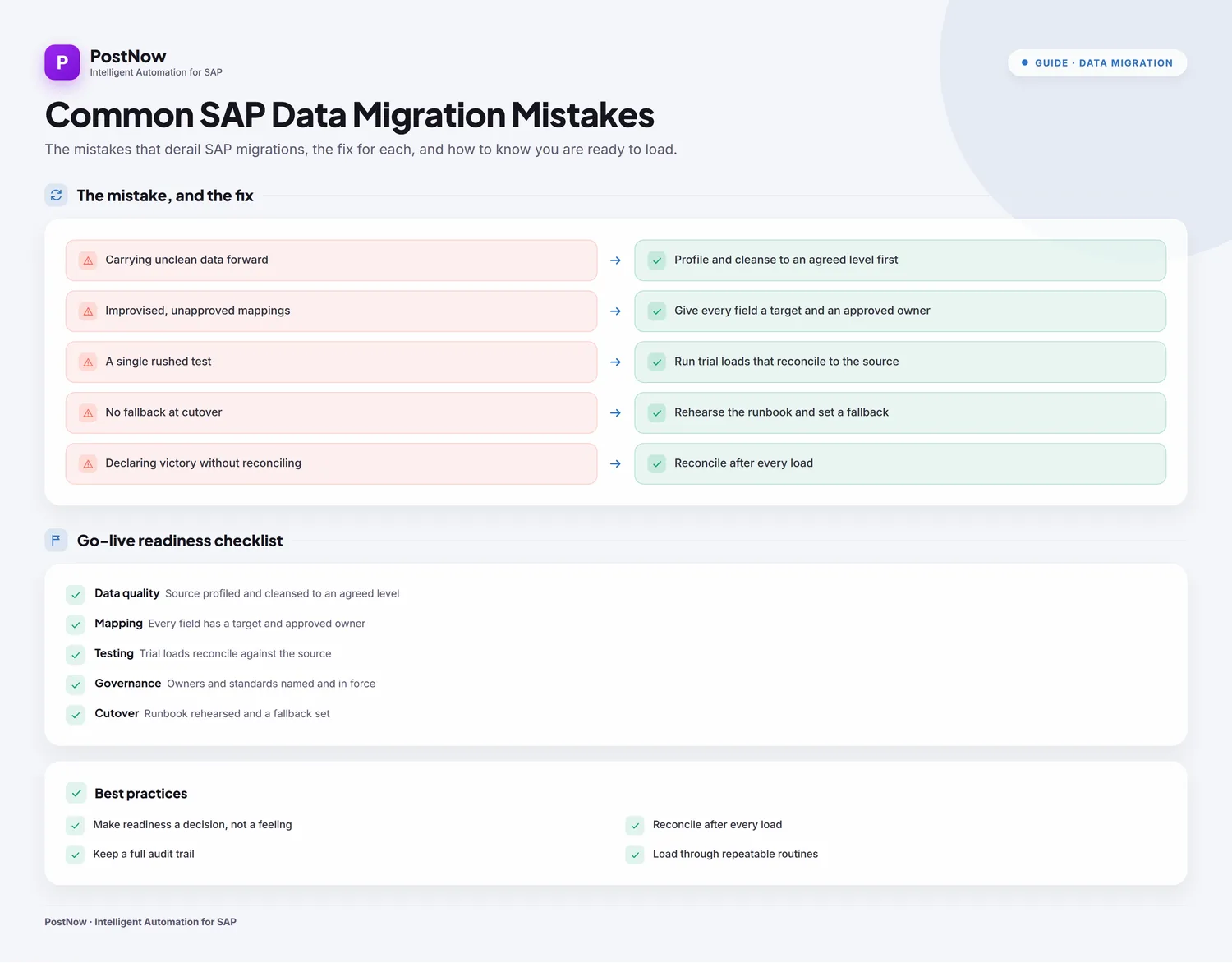
Organizations meet these pitfalls during new implementations, system consolidations, and moves to S/4HANA. The trigger varies, but the failure patterns are remarkably consistent, and most of the pain traces back to a small set of avoidable errors.
This guide names those mistakes plainly, explains what goes wrong in each, and gives a direct way to avoid it. For the positive counterpart, see the data migration best practices guide; for the wider discipline, the SAP data migration pillar sets the scene.
It is written for program leads and data teams who would rather learn these lessons from a page than from a painful go-live.
There is a quiet comfort in how repetitive these failures are. A team facing its first migration can study the mistakes others have already made and skip most of the suffering, which is a rare advantage in any complex undertaking.
This guide deliberately pairs each mistake with its remedy rather than dwelling on failure, because the point is not to alarm but to equip. Read it defensively: for every pattern described, ask whether your current plan has the matching safeguard in place.
Worth saying plainly: none of the mistakes here is a sign of an incapable team. They befall experienced groups too, usually when scope grows or timelines compress. Treating them as systemic risks to manage, rather than personal failings to fear, is the healthiest way to keep them at bay.
The structure that follows moves from understanding to action: first why migrations fail, then where the risks appear, then how to mitigate each one, and finally a checklist to confirm you have. Readers in a hurry can jump straight to the mitigation table and the risk checklist and still come away with the essentials.
Core concepts: why migrations fail
Almost every migration failure falls into one of six categories. Recognizing them is the first step to avoiding them.
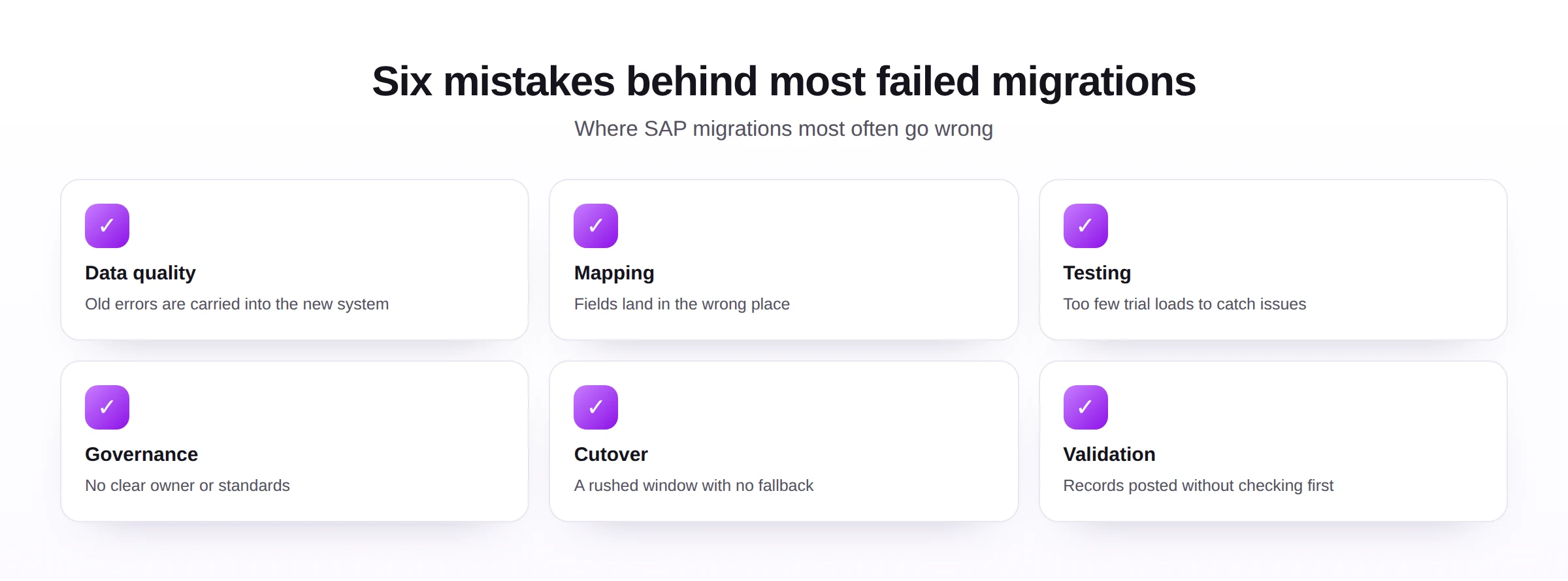
It is worth resisting the urge to rank these by severity in the abstract, because their impact depends on your data. For one organization mapping is the great danger; for another it is cutover. The value of the list is its breadth, making sure none of the six is quietly ignored.
The six are linked. Poor data quality makes mapping harder, weak mapping makes testing noisier, thin testing hides cutover risk, and skipped validation lets all of it through. They tend to compound, which is why a migration that neglects one often struggles with several.
They are also, every one of them, failures of preparation rather than technology. None is caused by a tool being incapable; each is caused by a step done too late, too lightly, or not at all. That is encouraging, because preparation is something a team fully controls.
Framing them as preparation failures also reframes the fix. You do not need a better tool to avoid them; you need to do ordinary things in the right order and at the right time. That is a far more reassuring position than hoping technology will rescue a rushed plan.
It also helps to share this list widely across a migration team. Mistakes often happen at the seams between roles, where each person assumes someone else owns a check. A common vocabulary for the six risks makes those seams visible and easier to close.
With the categories in view, the next step is to recognize the settings where each one tends to appear in practice.
Business scenarios
These mistakes surface in recognizable situations. Knowing where they lurk helps you watch for them.
- First-time implementations, where teams underestimate how much source cleansing is needed.
- Consolidations, where merging systems exposes conflicting and duplicated records.
- S/4HANA moves, where simplifications break mappings that were never revisited.
- Tight timelines, where testing is the first thing sacrificed under pressure.
- Complex objects, such as the Business Partner, where weak mapping does the most damage.
The common thread is pressure. Each mistake becomes far more likely when time is short and corners look tempting, which is exactly when a clear list of risks is most valuable.
Pressure is worth naming explicitly because it is the real adversary. The mistakes themselves are obvious in hindsight; what makes them happen is a deadline that tempts a team to defer the unglamorous work. Building the safeguards into the plan, so they cannot easily be skipped, is the practical answer to that pressure.
None of the mitigations below is novel, and that is the point. They are the well-worn practices experienced teams treat as non-negotiable, precisely because they have seen what happens when each is skipped. Their familiarity is a feature, not a weakness.
Recommended approaches: mitigation strategies
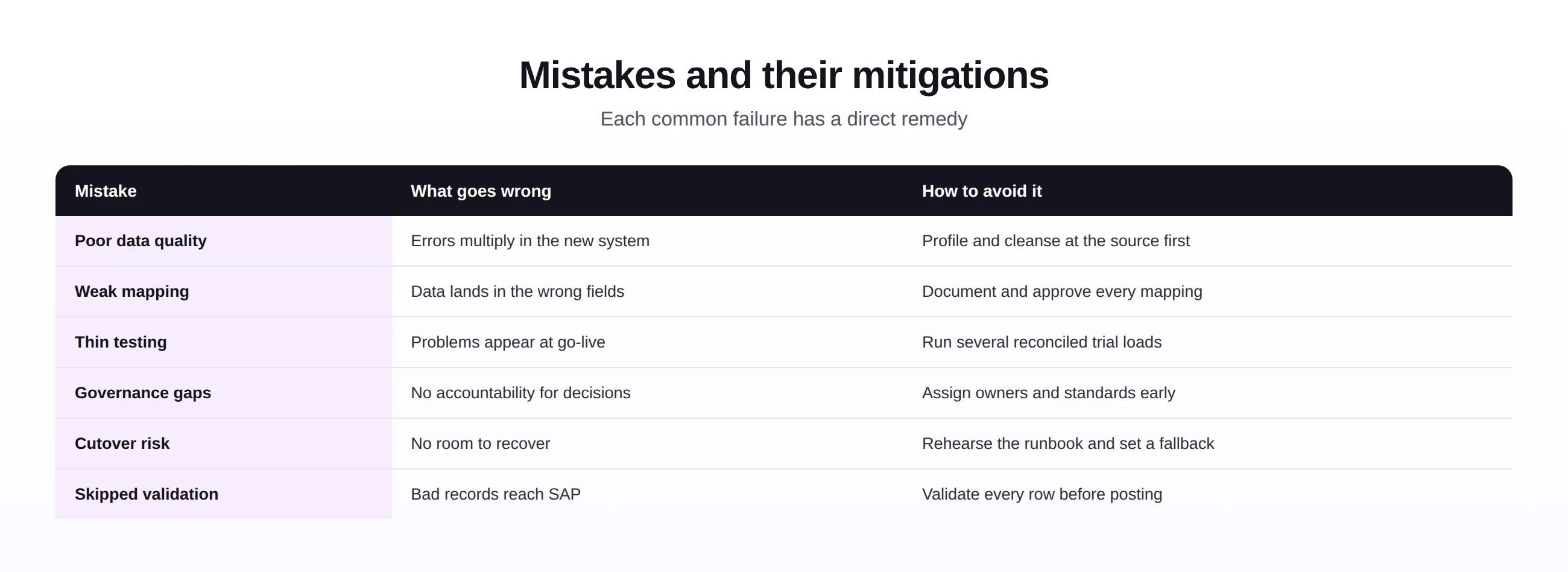
Every mistake on the list has a direct, well-proven mitigation. None of them is complicated; they simply have to be done in time.
For data quality and validation
Profile the source early to quantify the problems, cleanse them where the data originates, and validate every record against SAP rules before it loads. This pair of habits stops the largest class of failures at its root, anchored in solid master data management.
The reason source cleansing beats fixing data later is permanence. A correction made in the source improves every future extract and every system that draws from it, while a fix applied only during the load has to be repeated and tends to be forgotten. Cleaning at the source is the gift that keeps giving.
For mapping and testing
Document every source-to-target mapping and have an owner approve it, then prove it with several trial loads that are reconciled against the source. Mapping decisions made in writing, and tested more than once, rarely cause cutover surprises.
On testing, the number of rehearsals matters more than their polish. One immaculate test proves little, because the conditions that break a migration are often the odd ones a single run never encounters. Several honest trial loads, including deliberately messy data, reveal far more about how the real load will behave.
For governance and cutover
Assign clear owners and standards through master data governance, and rehearse the cutover with a written runbook and a defined fallback. Accountability and rehearsal turn the two riskiest areas into managed ones.
Governance and cutover are often treated as afterthoughts, which is precisely why they fail. Deciding who owns a mapping, or what happens if a cutover step stalls, is uncomfortable work best done calmly in advance rather than frantically in the moment. The discomfort of planning is always smaller than the discomfort of improvising.
One subtle benefit of a written checklist is that it depersonalizes the go or no-go decision. Instead of someone having to argue against a launch, the unticked boxes make the case, which is far easier in a room under pressure than relying on a single voice to raise concerns.
A migration risk checklist
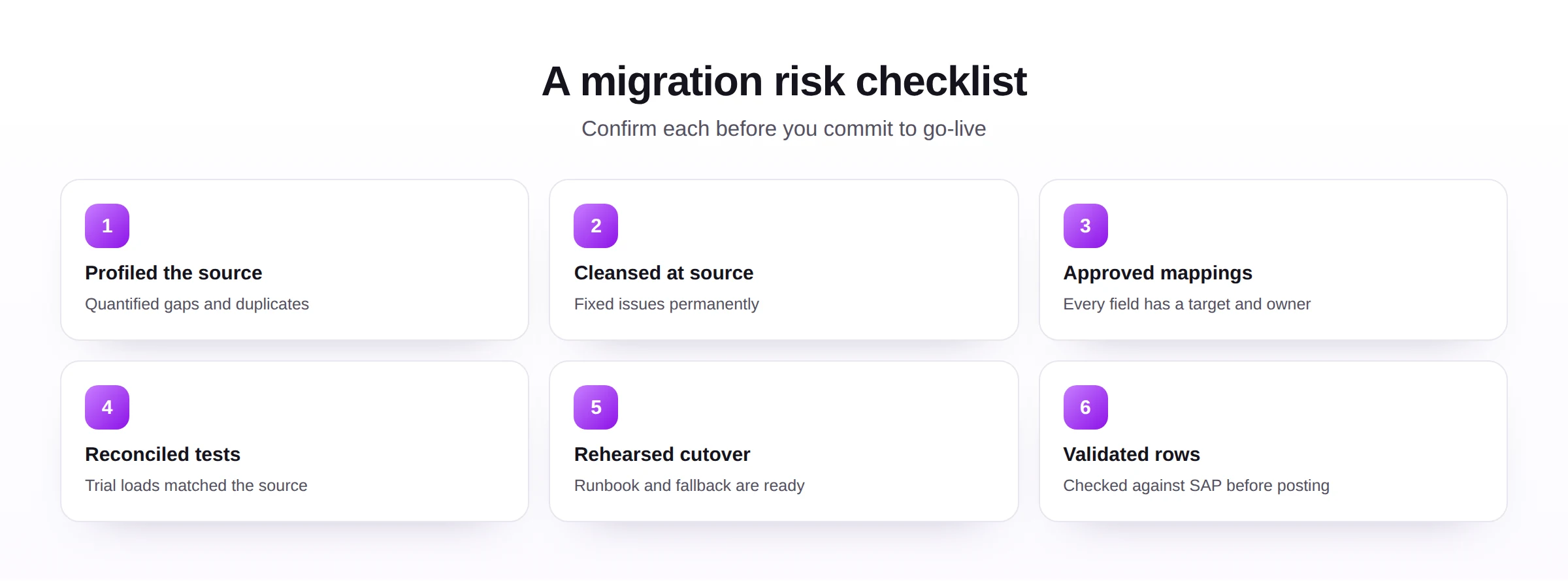
Use this checklist as a go-live gate. If any item is unchecked, the risk it represents is still live.
| Risk area | Confirmed when... |
|---|---|
| Data quality | The source is profiled and cleansed to an agreed level. |
| Mapping | Every field has a target and an approved owner. |
| Testing | Trial loads reconcile against the source. |
| Governance | Owners and standards are named and in force. |
| Cutover | The runbook is rehearsed and a fallback is set. |
| Validation | Rows are checked against SAP before posting. |
The checklist works because it makes risk visible. A migration where every box is ticked is not guaranteed to be perfect, but it has removed the failures that sink most projects, which is the realistic goal.
A useful discipline is to treat any unticked box as a blocker rather than a note. It is tempting, under deadline, to wave through a near-complete checklist, but the items most likely to be skipped are usually the ones guarding the biggest risks. A checklist only protects you if its verdict is allowed to stop the launch.
The mistakes that hurt most
If the list had to be shortened to the failures with the widest blast radius, these would lead it.
What makes these the worst is reach. A quality or mapping error does not affect one record; it affects every record that shares the flaw, which at migration scale can mean the whole load. Catching them early is therefore worth far more than the effort it takes.
The reach of these failures is also why early detection is worth so much. Finding a mapping flaw in a trial load costs an afternoon; finding it after go-live can cost a project its credibility. The same defect carries wildly different price tags depending only on when it is caught, which is the strongest possible argument for testing early.
Best practices
Beyond avoiding specific mistakes, a few habits make the whole migration more resilient.
- Make readiness a decision, not a feeling, with criteria everyone can see.
- Reconcile after every load, so correctness is proven rather than assumed.
- Keep an audit trail, so every decision and load can be reviewed later.
- Load through repeatable routines, often from Excel via Excel to SAP automation, so rehearsal and reality match.
- Reuse the approach across objects, supported by broader automation tools.
These practices favor auditability, repeatability, and scalability. A migration built on them is not only less likely to fail; it leaves behind a cleaner, better-governed data set than it started with.
It is worth noting that a well-run migration improves data, rather than merely moving it. Because the discipline forces profiling, cleansing, and reconciliation, the records that arrive in the new system are often cleaner than those that left the old one. Approached this way, a migration becomes an opportunity as much as a risk.
Future trends
Tools are getting better at catching these mistakes early, though the disciplines that prevent them are unchanged.
- AI-assisted profiling, surfacing quality issues and anomalies sooner.
- Assisted mapping, proposing source-to-target matches for a person to confirm.
- Automated reconciliation, comparing source and target with less manual effort.
- Continuous readiness, tracking risk as a live measure rather than a one-time check.
- Governance as evidence, capturing decisions and sign-offs as a record, not just activity.
However capable the tools become, they will keep punishing the same neglect and rewarding the same care. The mistakes in this guide are old, and the cures are older; technology simply makes the cures easier to apply.
For teams about to begin, the most useful takeaway is simple: schedule the unglamorous work first. Profiling, cleansing, mapping approval, and rehearsal are the steps most easily postponed and most expensive to skip, so protecting their place in the plan is the single best defense against the mistakes in this guide.
If there is one sentence to carry away, it is that migrations fail in slow motion. The cause is almost always a decision made weeks earlier to skip a check, and the remedy is almost always to honor that check at the time. Respect the boring steps, and the dramatic failures rarely arrive.