SAP business partner automation covers building and maintaining business partners from a spreadsheet rather than stepping through the BP transaction partner by partner. PostNow handles it from Excel by recording one creation, roles included, and replaying it: each partner is a row, the recording assigns the roles and fills their screens for every row, the values are checked, and the set posts in one pass, with every SAP message rendered in plain language.
Below is a twelve-step worked example of a business partner upload from Excel to SAP, taking in new partners and the extension of existing ones with extra roles. Keep the recording and mapping and you hold a business partner Excel template for the next data-migration wave. The business partner is the central object in S/4HANA, the single entry point behind customers and vendors alike, and once the initial setup is done, whoever loads the data writes no ABAP and needs no developer on call.
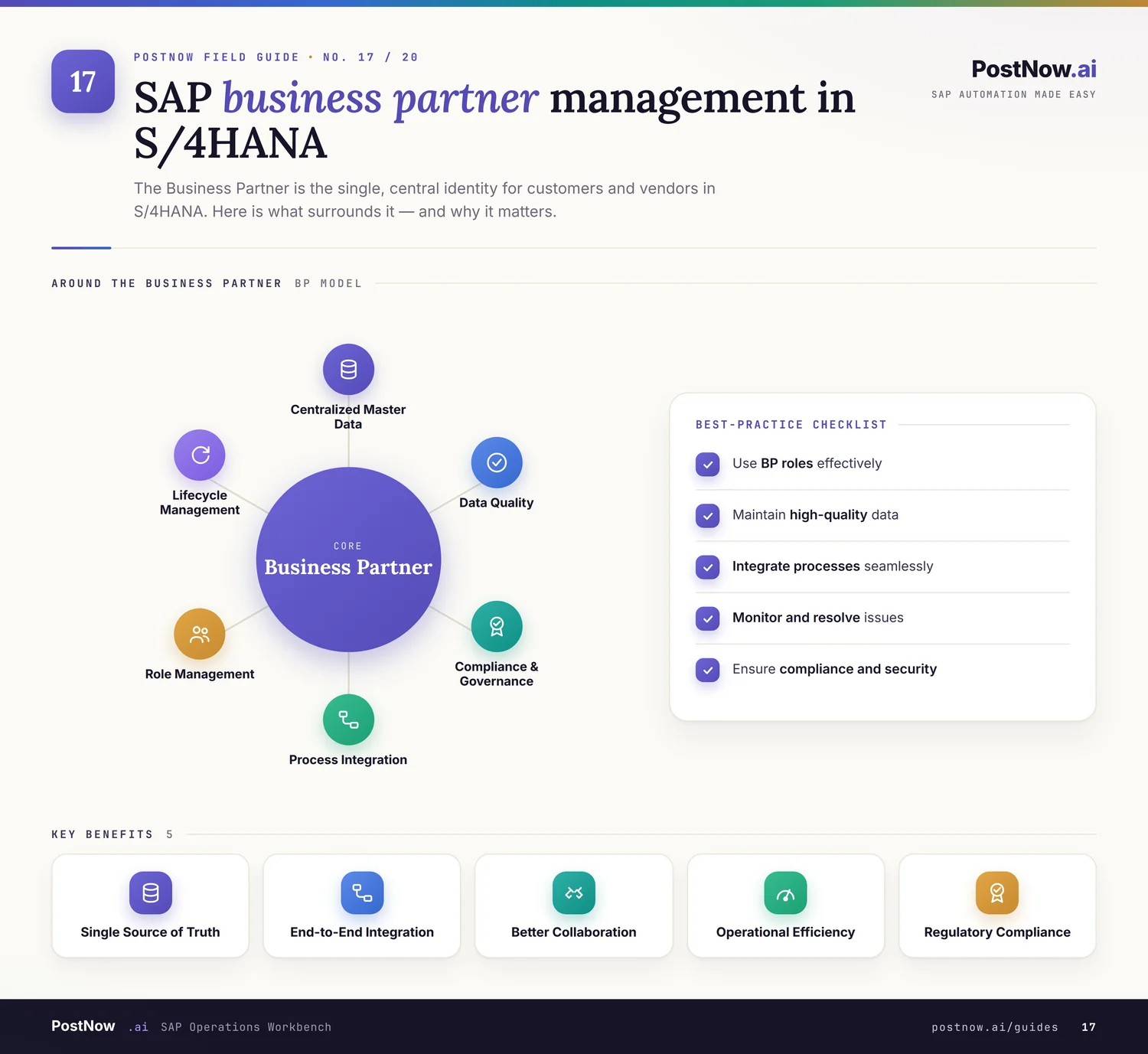
Why automate business partner creation rather than keying BP
Creating a partner manually means opening BP, picking the grouping and category, entering the name and address, then adding each role in turn, the customer role with its accounting and sales views, or the vendor role with its accounting and purchasing views, completing the fields each role exposes. One or two is fine. A migration that brings thousands of partners, each with a different mix of roles, becomes a long stretch of repetitive role switching, and that is where a missing role or an inconsistent grouping slips in.
A business partner upload removes that repetition. The partners sit in Excel and the recording posts the whole set, every role assigned, in one run. For a bulk BP creation at go-live or a mass business partner upload during a conversion, the demanding parts, capturing the role flow, matching columns to fields, formatting the data, and reading SAP messages, are taken off you. The twelve steps below cover the method end to end.
Before you start: what you need
- Your partners in Excel, one per row, with columns for the grouping, category, general data, the roles to assign, and the data each role needs.
- SAP authorization for the
BPtransaction across the groupings and roles you are loading, including any company code or sales area the customer or vendor roles touch. - PostNow in Excel, attached to your SAP system. Its supporting components are installed in SAP once during setup, after which every business partner load runs from the task pane.
KNA1 or LFA1 master automatically, so a single load keeps the partner and its classic masters aligned.Your business partner Excel template: the fields SAP expects
A business partner has shared general data plus whatever each assigned role adds, so the template lays out general columns and then role columns. These are the fields a partner upload turns on; carry them, and make sure the grouping, roles, and any company code or sales area they use already exist.
| Excel column | SAP field | Why it matters |
|---|---|---|
| Grouping | BU_GROUP | Chosen first; it controls the number range and whether the key is internal or external |
| Category | person / org / group | Decides which name and address fields the partner uses |
| Name & address | general data | Shared identity, common to every role the partner holds |
| Roles | FLCU00, FLCU01, FLVN00, FLVN01 | The customer and vendor roles, in their FI and sales or purchasing variants |
| Company code data | role data | Reconciliation account and terms for the FI roles |
| Sales / purchasing data | role data | Sales area or purchasing org settings for the selling and buying roles |
BP transaction, and a clean end-to-end BAPI rarely covers every role and integration step, so PostNow uses a transaction recording. You run one BP creation, choosing the grouping and category and adding each role, while PostNow captures the sequence and the fields entered on every role screen. That recording is a reusable template the add-in replays for each row, the field values taken from your columns, and customer-vendor integration runs as part of the replay. Step 2 is where you capture it.The business partner upload, step by step
Lay out and open your sheet
Set out each partner on a row under headers such as Grouping, Category, Name, City, Roles, Reconciliation Account, Sales Org, and Purchasing Org. Open the workbook and bring up the PostNow task pane alongside.
Record the BP transaction
Since a partner is assembled from roles rather than a single flat call, you capture the flow once. Begin a recording, create one partner in BP with the roles you need, and PostNow follows along:
- It captures the grouping and category choice and the general data screen
- It records each role you add, with the company code, sales area, or purchasing fields it carries
- One capture is enough; the recording then drives every partner in the sheet
Save it and PostNow makes it a reusable template, so building business partners from Excel to SAP never again means switching roles in BP yourself.
Look over the recorded roles and fields
PostNow presents the recording as the general screen plus each role it stepped into, with the fields it will set on every one. Because it mirrors the real BP flow, a quick read shows what is captured at each level:
That shows, before any mapping, which column belongs to general data and which to a particular role.
Open the Mapping Designer
The recording fills the Mapping Designer with a line per captured field, across every role. Two notes for partners:
- Added fields are detected. Extra fields a role exposes in your configuration are picked up, ready to map.
- You can add more manually. Any field the recording did not reach you place yourself, keeping the full partner in one load.
Match columns with Mapping AI AI
Now bind the recording to your sheet. Mapping AI studies your headers, or a screenshot you paste, and offers an Excel column for each recorded field, which you keep or change, a clear time-saver when a partner carries several roles each with their own fields.
Auto Map and stamp the headers
Run Auto Map to settle the mapping. Each recorded field is tied to its column and SAP-tagged headers are written into the sheet, so the workbook becomes the template and tracks the recording across its roles.
Set formatting and update flags
Each field's properties set how its value is entered on the role screen: leading zeros on account fields, upper case on org codes, trimmed spaces, defaults, and regex. With these in place the replay types precisely what each role expects.
When the recording adds a role to an existing partner rather than creating one, you flag only the fields the replay should write, so extending partners in bulk affects just the role data you intend.
Check the data in Excel first
Checking before the replay is worth it: a grouping or role error usually stops the screen partway. Validate brings that check forward, measuring each row against SAP's length, format, and required-field rules and flagging the cells at fault, so the sheet is sound before the recording runs.
Confirm against live SAP
Tidy formatting still does not prove a value is real, a role or company code can read fine and be unavailable. To test it, open the field's properties, switch on field validation, and give it the check table and field, a company code against T001, a sales organisation against its setup, or the grouping against its definition. Select the cell, run Validate master data, and PostNow asks live SAP whether the value exists.
Shape the load with loops and conditions
When the sheet needs more than a flat replay, set it up first:
- Loops: the recording steps down the rows, building one partner after another from the same captured flow.
- IF conditions: apply a role only where the data calls for it, for instance adding the vendor role only when purchasing data is present, or skipping rows with no grouping yet.
Set the scope, run, and review AI
Set the range with Run Scope, one test partner before the rest, and press Run. A few things help:
- Foreground replay: watch the recording move through the roles for the first partner to confirm it behaves.
- Run log: each result appears live and lands in a log column against its row in Excel.
- AI error review: AI Review reads the SAP message and explains, plainly, which role and field stopped the partner.
- Per-row result: every partner carries its own outcome, so a failure points straight at the row and field to fix.
Publish and roll it out to the team
With the run clean, publish. The recording and mapping become a script colleagues run as is, they open it, paste their partners, and post, with nothing to rebuild and no need to grasp the roles behind it. One setup becomes the team's standard route for loading business partners.
Let's talk
Bring a real business partner list and a live SAP connection to a working session. We will record the BP transaction with its roles, map the fields, validate, and post it for real, with AI taking the strain. No slide decks.
Frequently asked questions
What is SAP business partner automation?
BP transaction one partner at a time. PostNow records a BP creation with its roles once and replays it for every row in Excel, while AI maps the fields, checks the values, and explains any error, with no ABAP for the people loading the data.How do you upload business partners from Excel to SAP?
BP creation once, map your columns to the recorded fields, validate, then replay the recording for the whole list. PostNow checks the data against live SAP, so there is no BP keying and no ABAP.How are business partner roles handled in the upload?
KNA1 or LFA1 records aligned.Is there a template for uploading business partners to SAP?
Can you add a role to existing business partners from Excel?
BP change that adds the role and its data, list the partners with their values, and mark the fields the replay should write. PostNow runs the change for every row, the Excel route to extending business partners in bulk without touching the BP transaction manually.