SAP LSMW Alternative
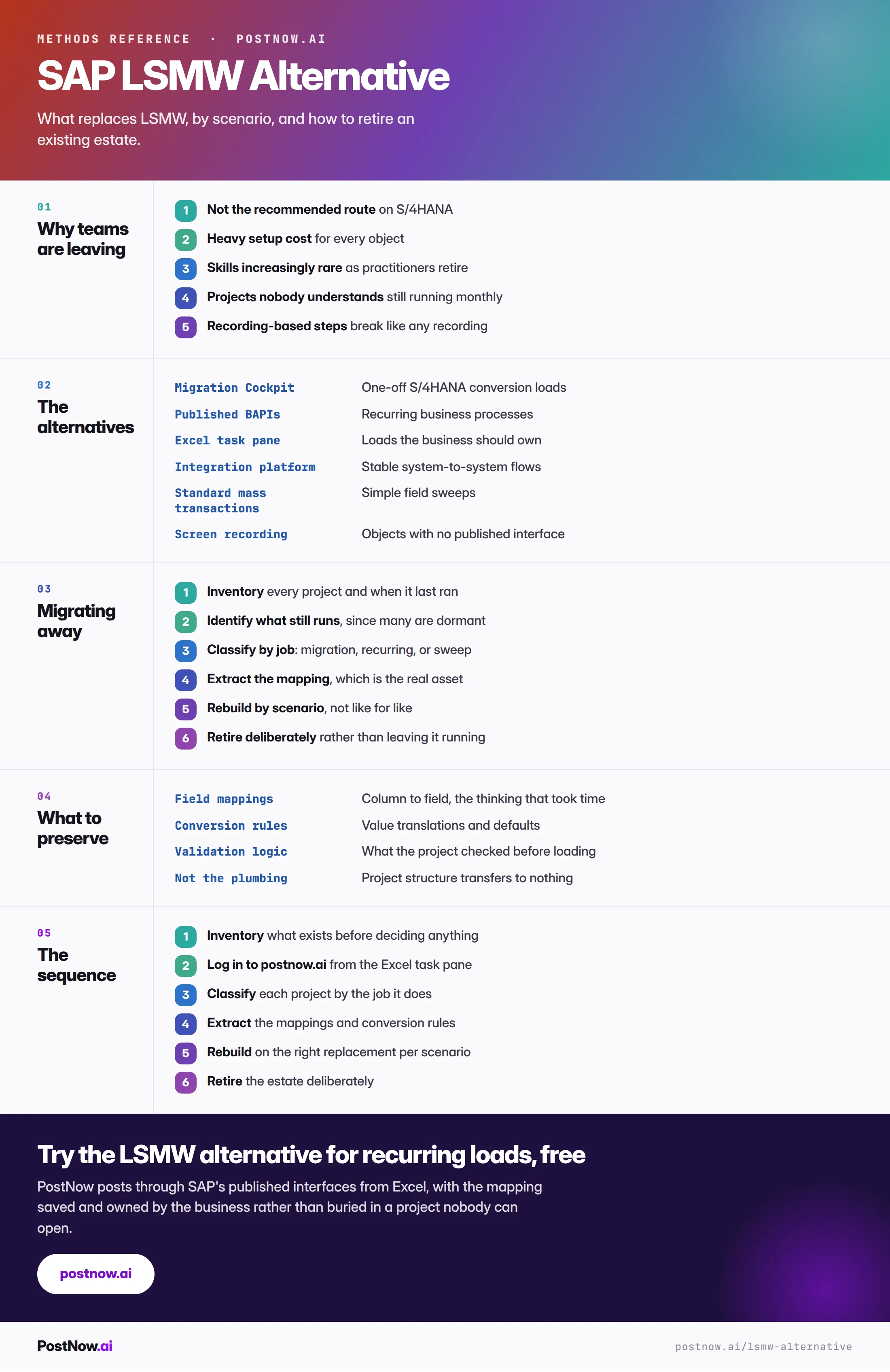
LSMW provided a structured framework for complex mappings and remains defensible for one-off migration on ECC. Teams are moving away because it is not the recommended route on S/4HANA, setup cost per object is heavy, the skills are increasingly rare, and projects nobody understands are still running monthly.
- There is no single successor. LSMW covered several distinct jobs, so replacing it means naming which job each project was doing.
- Migration Cockpit for cutover, published BAPIs for recurring loads. Those two cover most of a typical estate between them.
- Inventory first. Estates are usually larger than expected and less used than assumed, and half is often retirable without replacement.
- The mapping is the asset. Field relationships and conversion rules transfer between tools; the project structure does not and need not.
- Extract before decommissioning. Once the project is gone, so is the only documentation of what it did.
Why teams are looking for an LSMW alternative
The Legacy System Migration Workbench did real work for two decades. It provided a structured framework for complex mappings, with conversion rules, fixed values and translations built in, covering many objects through one tool that was already installed and free. For one-off migration work on an ECC system it remains defensible.
The reasons to move away are practical rather than ideological, and there are four of them.
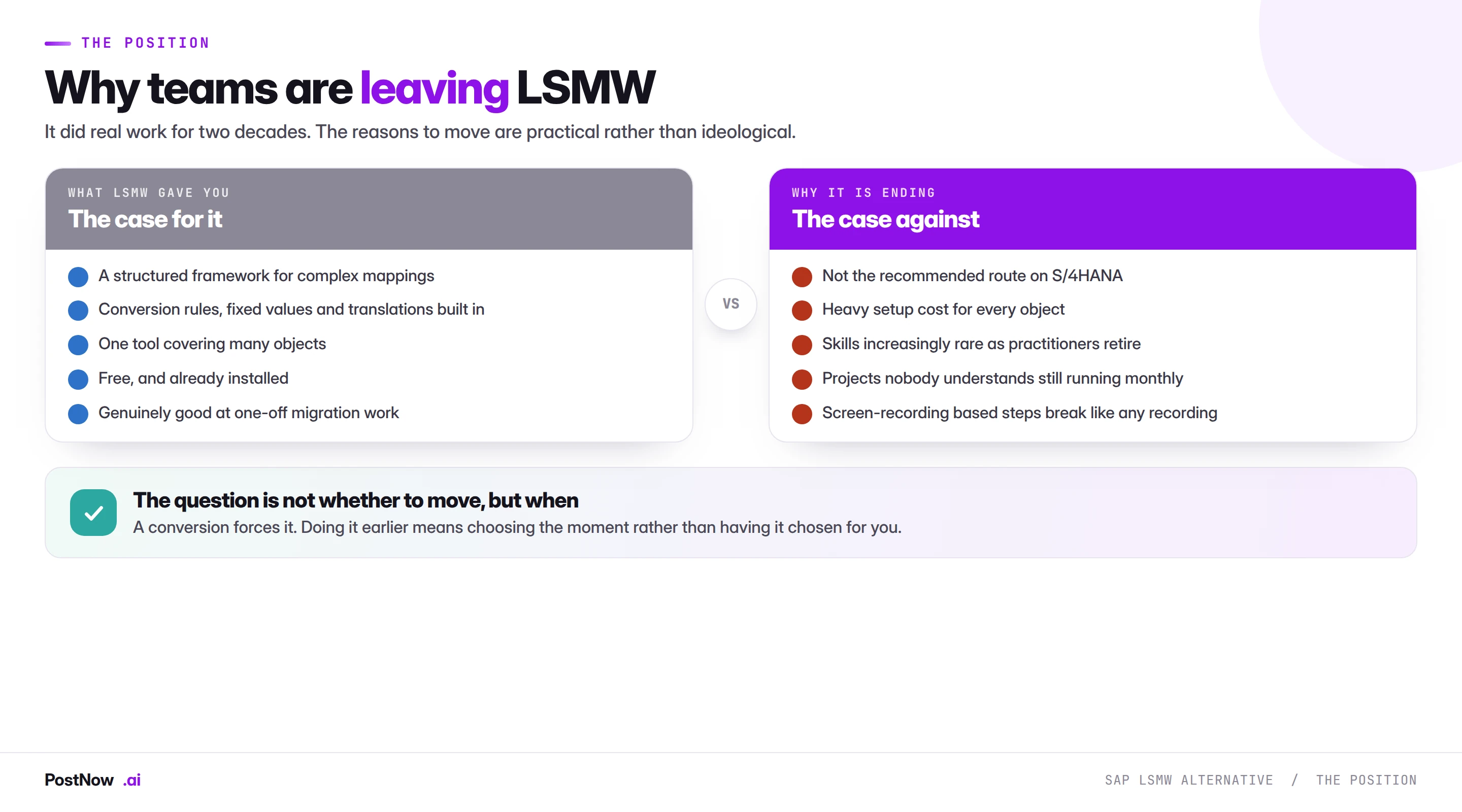
It is not the recommended route on S/4HANA. Building new processes on it before a conversion means investing in something with a known end date.
The setup cost per object is heavy. LSMW rewards deep investment in a project and punishes casual use, which is fine for a migration and poor for anything recurring.
The skills are increasingly rare. Practitioners who built LSMW projects fluently are retiring, and the people inheriting those projects frequently cannot modify them.
Projects nobody understands are still running. The most common situation this guide addresses: a monthly load built years ago by somebody who left, which works until it does not.
What replaces it, by scenario
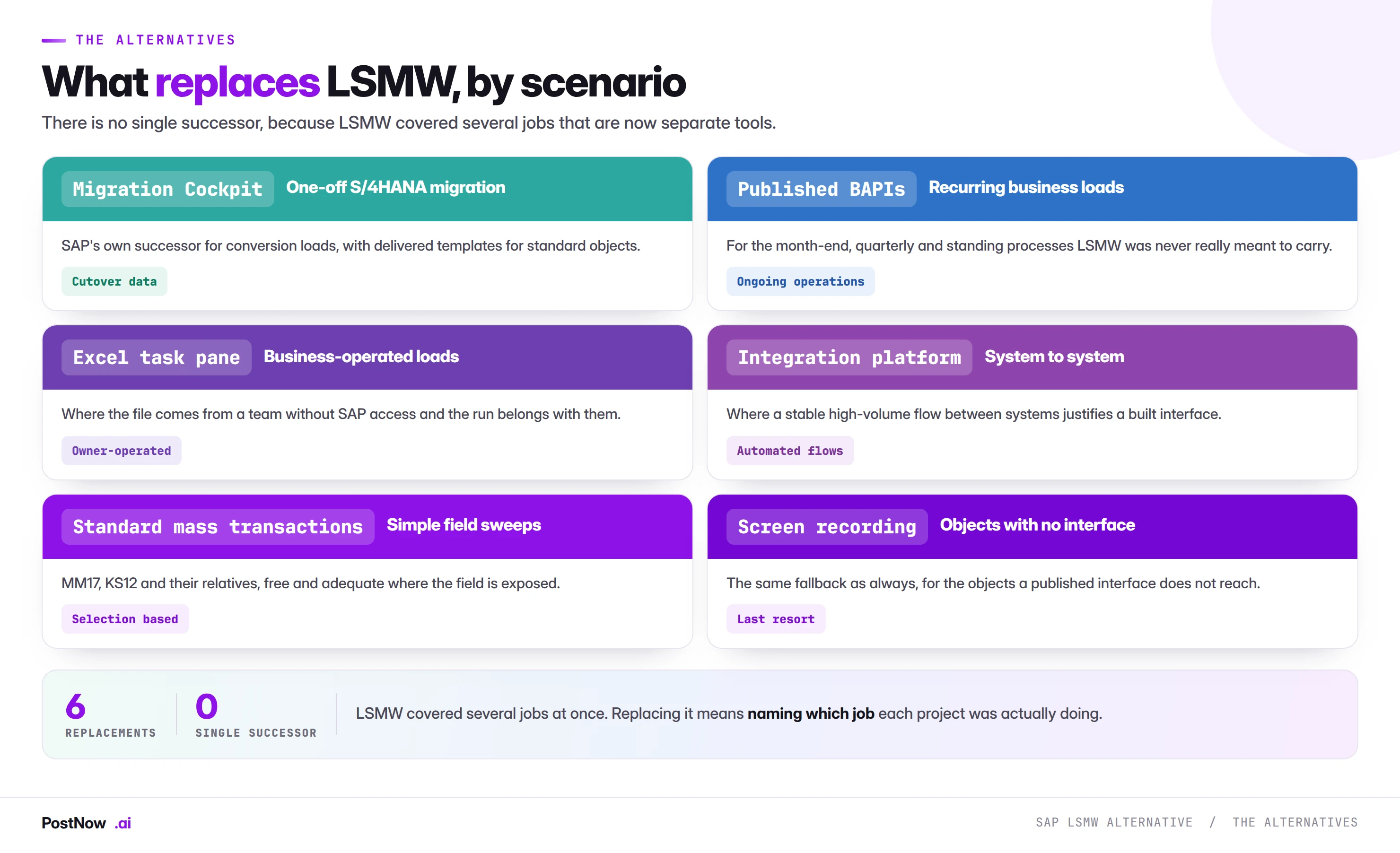
There is no single successor, and expecting one is the reason replacement projects stall. LSMW covered several distinct jobs at once, and replacing it means naming which job each project was actually doing.
Migration Cockpit for one-off S/4HANA conversion. SAP's own successor for cutover loads, with delivered templates for standard objects. Where the job is genuinely migration, this is the intended path.
Published BAPIs for recurring business loads. The month-end accrual, the quarterly price list, the monthly plant extension. These were never really what LSMW was for, and they are what a published interface handles well. The BAPI comparison covers the mechanics.
An Excel task pane for loads the business should own. Where the file comes from finance, procurement or HR, and the people who own the numbers have no SAP access, the handover is the expensive part rather than the loading.
An integration platform for system-to-system flows. Where a stable high-volume flow between systems justifies a built interface, which is a different problem entirely.
Standard mass transactions for simple field sweeps. MM17, KS12 and their relatives are free, already there, and adequate where the field is exposed and the population comes from a selection screen.
Screen recording for objects with no interface. The same fallback as always, covered in the BDC recording guide.
Retiring an LSMW estate
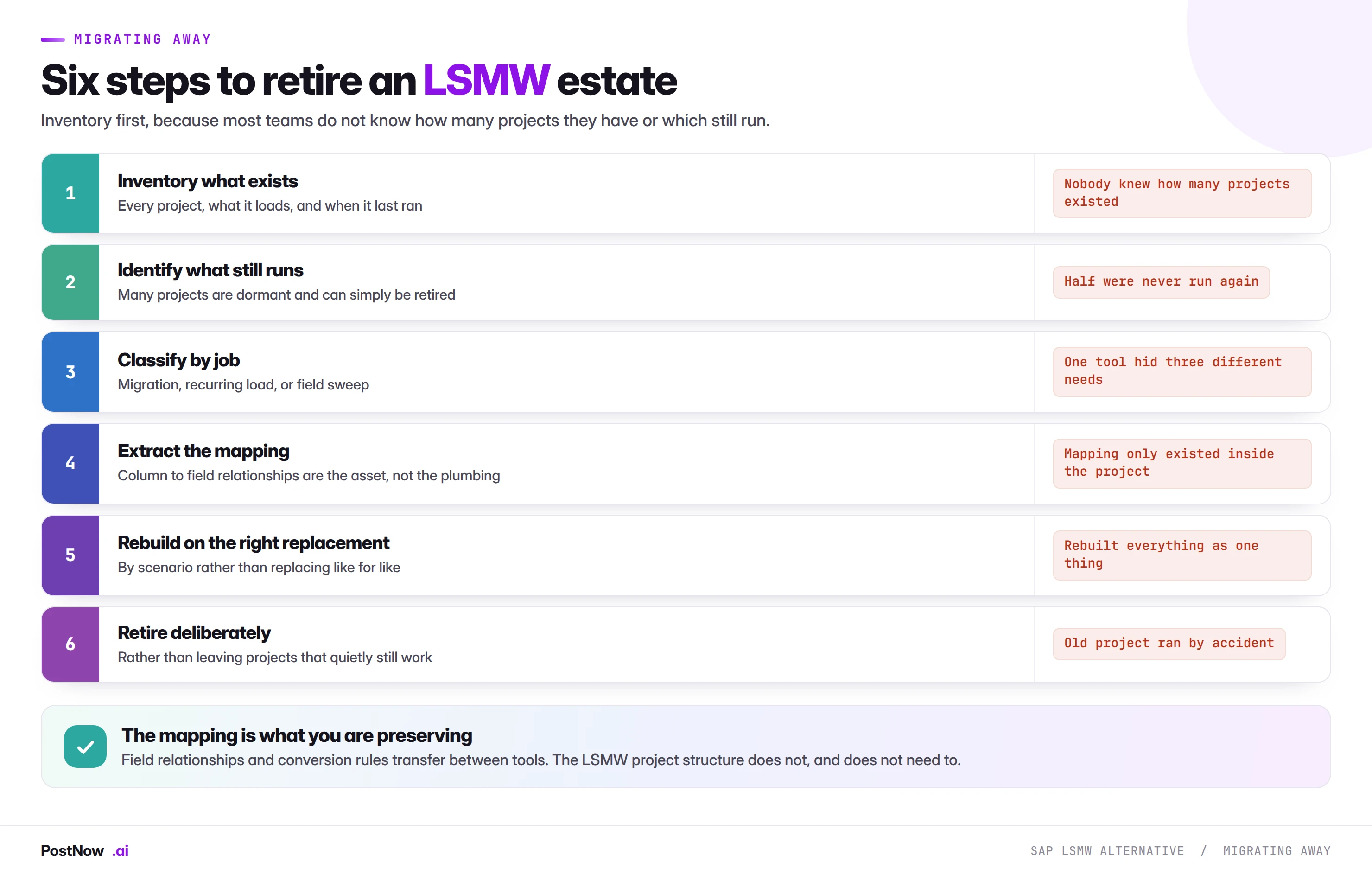
Six steps, and the first two matter more than the rest because most teams start without knowing what they have.
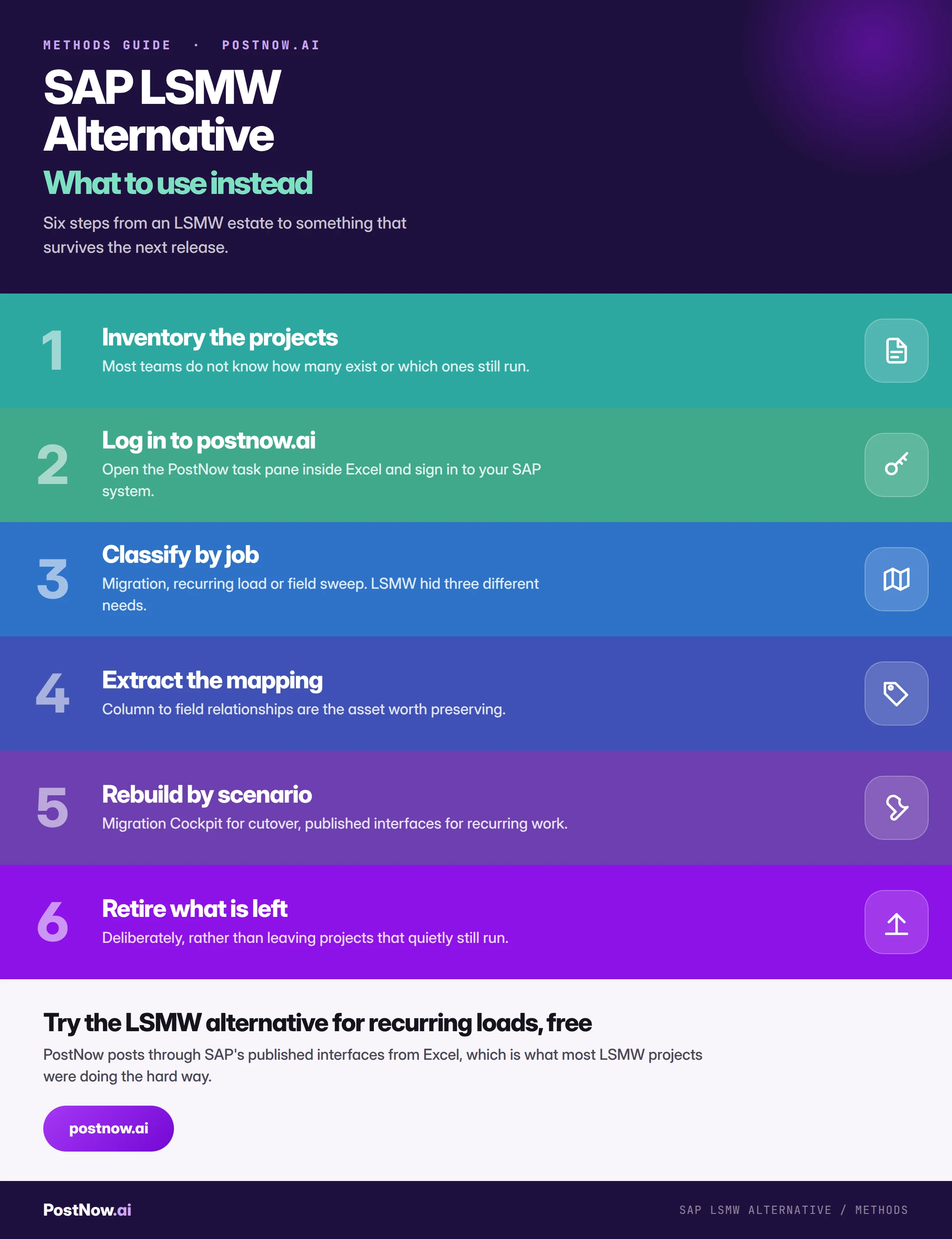
Inventory what exists. Every project, what it loads, when it last ran, and who built it. This is usually a surprise: estates are typically larger than expected and less used than assumed.
Identify what still runs. Many projects are dormant, built for a migration that finished years ago. Those can be retired without replacement, which is the cheapest possible outcome and frequently covers half the estate.
Classify by job. Migration, recurring load, or field sweep. One tool hid three different needs, and each has a different replacement.
Extract the mapping. The column-to-field relationships and conversion rules are the asset. They took the thinking, they encode business knowledge, and they transfer between tools. The LSMW project structure does not transfer and does not need to.
Rebuild on the right replacement. By scenario rather than like for like. Replacing every project with one new tool reproduces the original mistake of making one thing serve several jobs.
Retire deliberately. Rather than leaving projects that quietly still work, because those are the ones that fail unattended in three years.
The mapping is what you are preserving
Worth stating separately because it changes how a replacement project should be scoped.
Every LSMW project contains two things: the intellectual work of deciding how source data maps to SAP fields, and the mechanical plumbing that executes it. The first took weeks and encodes decisions somebody made carefully. The second is a tool artefact.
When a project is rebuilt, the mapping carries forward and the plumbing is discarded. That reframes the effort considerably: you are not rebuilding from nothing, you are re-implementing a specification that already exists inside the old project.
- Field mappings. Which source column feeds which SAP field, at which organisational level.
- Conversion rules. Value translations, fixed values, defaults and derivations.
- Validation logic. What the project checked before loading, which is often knowledge that exists nowhere else.
- Sequencing. Which objects had to load before which others.
Extracting these before decommissioning is the difference between a replacement project and an archaeology project. Once the LSMW project is gone, so is the only documentation of what it did.
For the recurring loads
PostNow covers the recurring half of an LSMW estate
Most LSMW projects that still run monthly are doing what a published interface handles directly. PostNow adds a task pane to Excel, signs in with your own credentials, and posts through SAP's BAPIs with the mapping saved where the business can see it.
The mapping lives with the business, not inside a project nobody can open.
Published interfaces, so validation and change documents behave normally.
Remaps at conversion rather than needing a rebuild.
Runs from Excel, by whoever prepares the file.
Moving away, step by step
When to do it
Three moments make sense, and one does not.
Ahead of a conversion. The best option. Projects need rebuilding anyway during an S/4HANA move, so doing it deliberately beforehand costs little more than doing it under go-live pressure, and produces something that survives the next change too.
When a project breaks. Reactive but reasonable. A project that has failed and needs fixing is a project already being touched, and rebuilding rather than patching is often comparable effort.
When the owner leaves. The moment the knowledge risk becomes concrete. If nobody remaining can modify a project that runs monthly, that is a dependency worth resolving before it fails.
Not all at once, on a schedule. Replacing an entire estate as a project produces a large effort with no visible benefit until it completes. Prioritising by fragility and frequency delivers value from the first replacement.
Common mistakes
- Looking for a single successor. LSMW covered several jobs, so replacing it needs several answers.
- Rebuilding like for like. Reproduces the original mistake of one tool serving every need.
- Decommissioning before extracting the mapping. The only documentation of what the project did disappears with it.
- Starting new LSMW projects now. Heavy setup for something with a known end date.
- Assuming dormant projects are needed. Half an estate is typically retirable without replacement.
- Leaving it until the conversion weekend. The worst possible time to discover how many projects exist.
The complete alternative reference
Go deeper
SAP data upload methods
The wider field, and the order of preference across all six methods.
SAP mass upload
The pillar guide covering validation, error handling and governance.