Introduction
Master data is the quiet foundation under every SAP process. When it is right, nothing draws attention to it; when it is wrong, the symptoms appear everywhere, from failed postings to reports no one trusts.
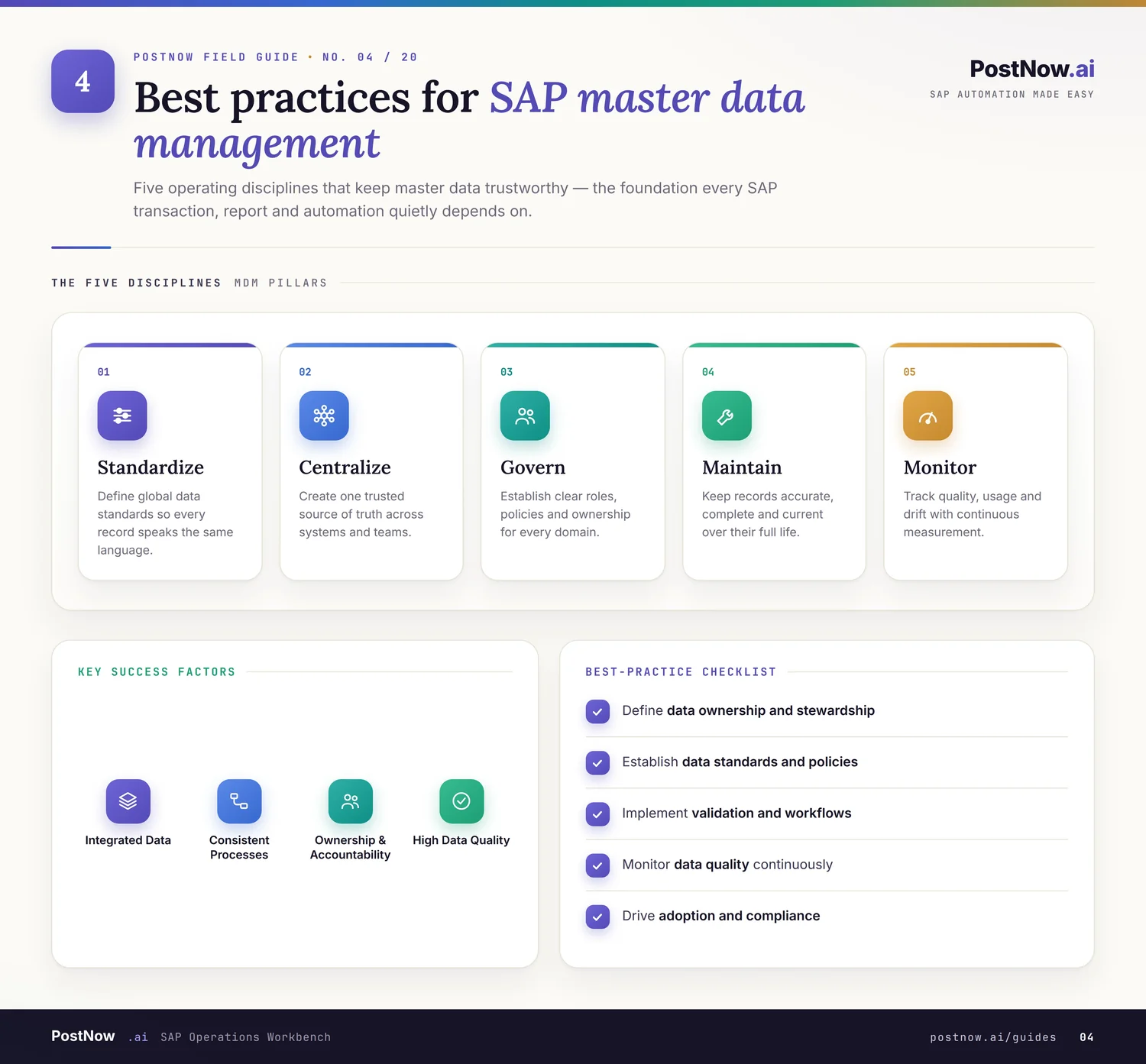
Organizations meet the need for better master data management at familiar moments: a report that does not add up, a duplicate vendor that causes a double payment, or an S/4HANA project that exposes years of accumulated mess. The lesson is always the same, that quality has to be managed deliberately rather than hoped for.
This guide gathers the practices that keep SAP master data accurate and trusted. Where the master data management pillar explains the discipline, this article focuses on the habits that make it work day to day.
It is written for the data leads, stewards, and SAP teams who live with this data, and it favors practical guidance over theory throughout.
It is worth stressing one point early: master data management is a practice, not a product. Tools help enormously, but the difference between clean and messy data usually comes down to whether people agreed on standards, owned the data, and kept at it. The habits matter more than the software.
There is also a strong business case behind the practice, beyond avoiding errors. Trusted master data speeds up everything downstream, from reporting to automation, because no one has to stop and question whether a record can be relied on. Clean data is, in a real sense, faster data.
It also pays to remember who ultimately benefits. Every clean master record quietly helps a finance analyst close faster, a buyer order from the right vendor, and a planner trust the numbers. Keeping those people in mind turns master data management from a back-office chore into work with a visible purpose.
Core concepts: what good master data looks like
Before improving quality, a team needs a shared idea of what quality means. A handful of dimensions capture it well.
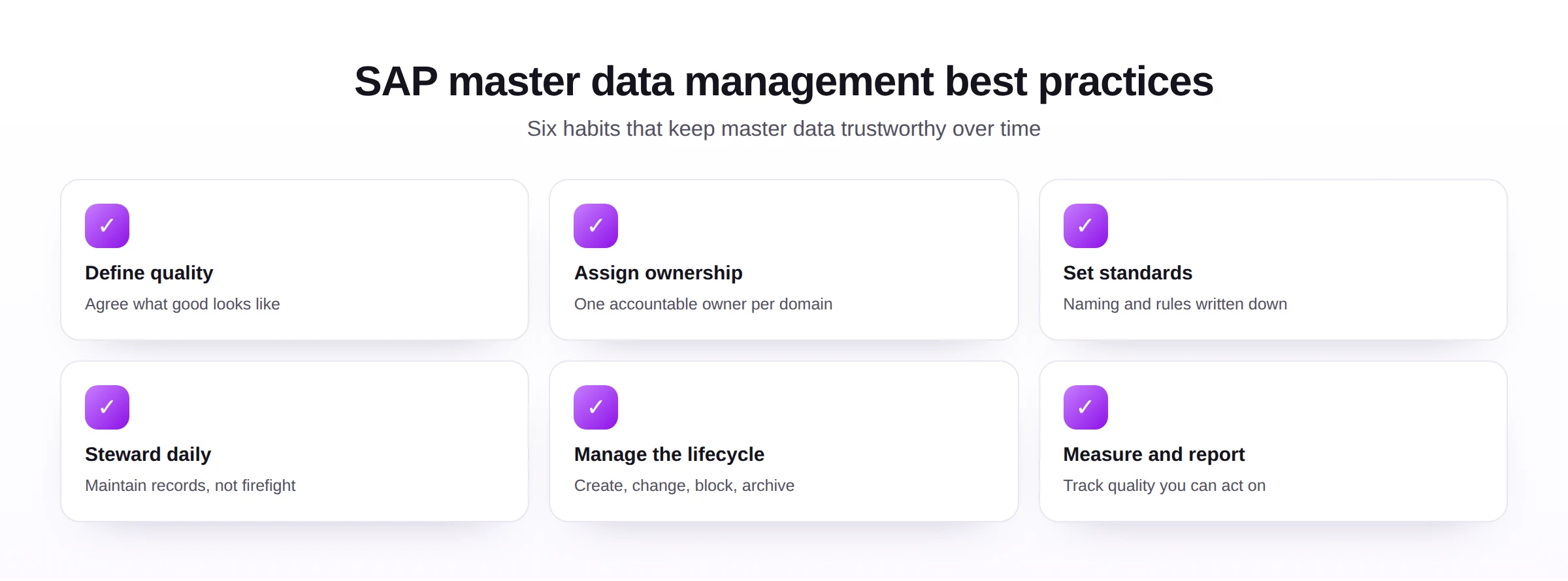
People sometimes treat data quality as a single yes-or-no property, but it is really several qualities at once. A record can be complete yet inaccurate, or accurate yet duplicated. Separating these dimensions is what lets a team diagnose a problem precisely instead of complaining vaguely.
These dimensions give a vocabulary for quality. Instead of saying data is bad, a team can say it is incomplete or inconsistent, which points straight at the fix.
They also make quality measurable. Each dimension can be checked, counted, and tracked, which turns an abstract goal into something a steward can work on and a manager can see.
With these dimensions in hand, quality stops being a matter of opinion. Two stewards looking at the same records will reach the same verdict, because they are measuring against shared definitions rather than personal taste. That shared language is the quiet enabler of everything that follows.
It also helps to connect each dimension to a real consequence people care about. Incompleteness blocks a posting, inconsistency breaks a report, and duplication causes a double payment. Tying the abstract dimension to the concrete pain makes the case for quality far more persuasive than any principle alone.
That sense of purpose is also what sustains the effort, because master data work is rarely urgent until it is too late. A team that remembers who depends on the data finds it easier to keep the routine going in the quiet weeks.
Common challenges
The obstacles to good master data are organizational at least as often as they are technical.
- No clear owner, so when a record is wrong, there is no one whose job it is to fix it.
- Duplicates, where the same vendor or customer exists several times under slight variations.
- Inconsistent entry, as different people fill the same fields in different ways.
- Decay over time, as addresses, contacts, and terms drift out of date.
- Quality as a project, treated as a one-time cleanup rather than an ongoing practice.
What stands out about these challenges is how few of them are really about technology. They are about clarity, ownership, and habit, which is encouraging, because those are things an organization can change without a major investment. The practices in the next section address each challenge directly.
One reassurance before the detail: you do not need to fix everything at once. Master data improves fastest when a team picks the dimension and domain that hurt most and concentrates there, then repeats. Breadth comes later; early momentum comes from depth on a problem that visibly matters.
Best practices
The practices below turn good intentions into reliable master data. They reinforce each other, so adopting several together works better than any one alone.
Manage data quality
Define quality in terms of the dimensions above, then check records against them routinely. Profiling reveals where the problems concentrate, so effort goes where it matters rather than spreading thin.
Routine matters more than intensity here. A modest quality check run every week beats a heroic cleanup run once a year, because master data decays continuously and only continuous attention keeps pace with it. Build the check into the rhythm of the team rather than saving it for a crisis.
Assign clear ownership
Give every master data domain a single accountable owner, supported by stewards who do the daily work. Ownership is the practice that makes all the others stick, because it gives quality a home.
Ownership should be unambiguous to be useful. Naming a committee or a whole department as owner tends to mean no one feels personally responsible. A single named person per domain, with stewards who report to them, gives every quality question a clear destination and every decision a clear decider.
Set standards
Write down naming conventions, mandatory fields, and the rules for valid values, and apply them everywhere. Standards are what let different people produce consistent records, and they are the backbone of any deduplication effort.
Standards only help if they are enforced where data is created, not just published in a document. A naming convention that lives in a forgotten wiki changes nothing; the same convention built into the entry process changes everything. Aim to make the standard the path of least resistance.
Practice stewardship
Treat stewardship as a steady routine, not a rescue mission. Stewards who maintain records continuously, resolve issues, and uphold standards prevent the slow decay that otherwise sets in.
Good stewardship is largely invisible, which is part of why it is undervalued. When stewards do their job well, records simply stay correct and no one notices. Recognizing and resourcing that steady work, even though it rarely produces dramatic wins, is one mark of a mature organization.
Govern the lifecycle
Manage each record across its whole life: creation with validation, controlled change, blocking when it falls out of use, and archiving at the end. A managed lifecycle keeps the data set from filling with stale and orphaned records.
- Validate at creation, so errors never enter, using repeatable loads such as Excel to SAP automation.
- Control changes through clear rules anchored in master data governance.
- Apply the same discipline to every domain, from the vendor and customer masters to the material master and Business Partner.
Notice how the practices interlock. Quality needs ownership to enforce it, ownership needs standards to apply, standards need stewardship to uphold them, and the lifecycle ties them across time. Adopt them as a set and they reinforce each other; adopt one alone and it tends to erode.
It is worth applying the lifecycle idea to the data set as a whole, not just individual records. A healthy master data domain is one where new records arrive validated, stale ones are retired, and the total stays purposeful rather than ballooning with entries no one uses. Pruning is as much a part of quality as creating.
A stewardship operating model and maturity path
Two simple models make the practices concrete: one for who does what, and one for how far you have come.
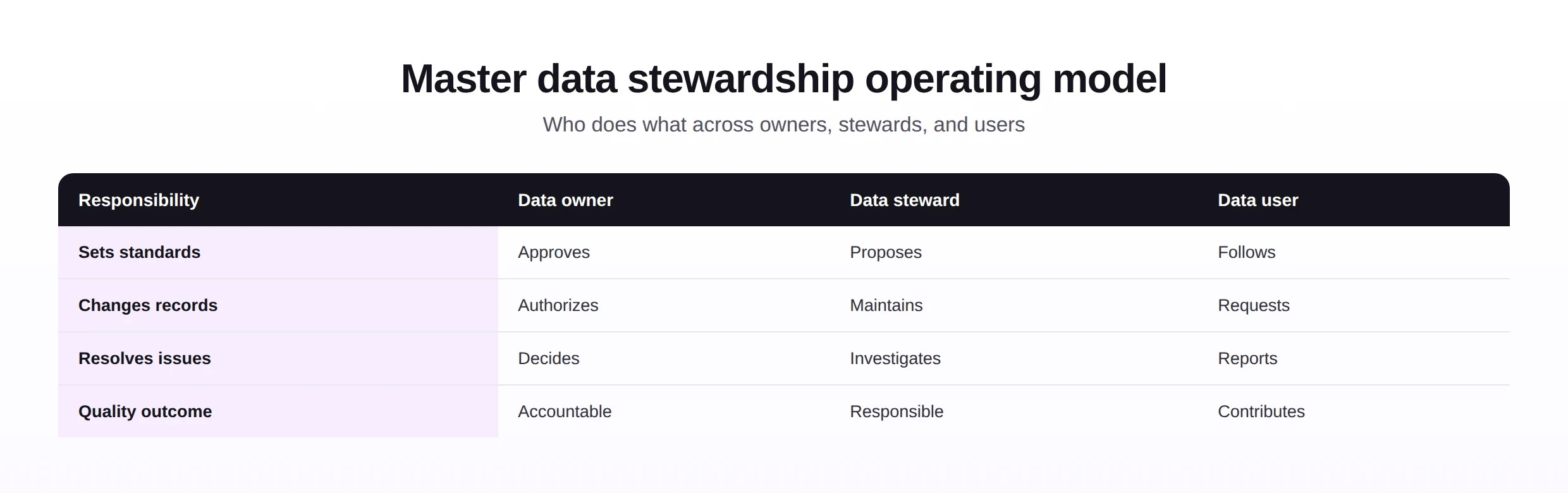
The operating model keeps roles clear. Owners set direction and are accountable for outcomes, stewards do the hands-on maintenance and investigation, and users follow the standards and report issues they see. When these roles are explicit, quality stops being everyone's vague responsibility and becomes someone's clear one.
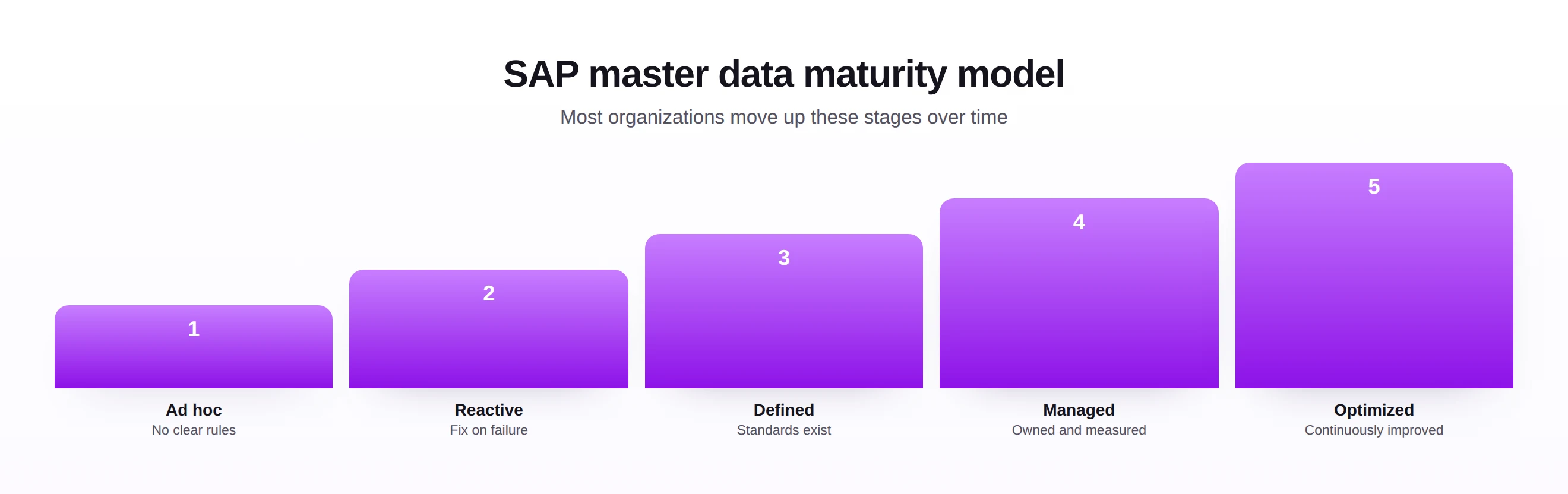
The maturity path helps a team locate itself honestly. Few start at the top, and that is fine; the value is in knowing the next stage and moving toward it deliberately, rather than mistaking occasional cleanups for genuine management.
Used together, the two models answer the questions teams most often stall on. The operating model answers who is responsible, and the maturity path answers what to improve next. Revisiting both periodically keeps a program moving rather than plateauing after the first burst of effort.
A practical aid here is a simple quality dashboard the whole team can see. When the measures are visible, they create gentle pressure to keep them healthy, and they turn quality from an IT concern into a shared one that owners and users both watch.
Common mistakes and how to avoid them
The mistakes below quietly undo good master data, and each has a direct remedy.
The antidotes mirror the practices: validate at the point of entry, name accountable owners, enforce standards in the tools people use, run stewardship as a continuous routine, and measure quality so you can see it slipping before users do.
If a single principle ties these mistakes together, it is the difference between cleaning and managing. Cleaning fixes the data you have today; managing changes how data is created and maintained so the problem does not return. Lasting quality comes from the second, with cleaning as a one-time reset along the way.
Future trends
Master data management is gaining better tools, but the core disciplines of ownership and quality are not going away.
- AI-assisted quality, suggesting matches, spotting duplicates, and flagging anomalies for a steward to confirm.
- Continuous monitoring, watching quality in real time rather than in periodic audits.
- Embedded governance, where rules are enforced at the point of entry through automation tools.
- Business-led stewardship, putting more of the work with the people who know the data best.
- Quality as a metric, reported alongside other operational measures rather than hidden in IT.
The tools will keep raising the floor, but they work best on a foundation of clear ownership and agreed standards. Technology can find a duplicate; only an owner can decide the rule that prevents the next one.
For teams deciding where to start, the advice is unglamorous but reliable: pick one domain, give it a clear owner, define and enforce its standards, and measure its quality. A single domain done well becomes the template, and the proof, for extending the practice across the rest of the master data.
The closing thought is that master data rewards patience. Few of these practices produce a dramatic before-and-after, but applied steadily they compound, and a year of consistent stewardship leaves a data set transformed. The organizations with the best master data are rarely the ones that tried hardest once; they are the ones that never stopped.