Why an ECC to S/4HANA migration is a data project
The move from SAP ECC to S/4HANA is often described as a technical upgrade. In practice, the part that decides whether it goes smoothly is the data, which makes it as much a data project as an IT one.
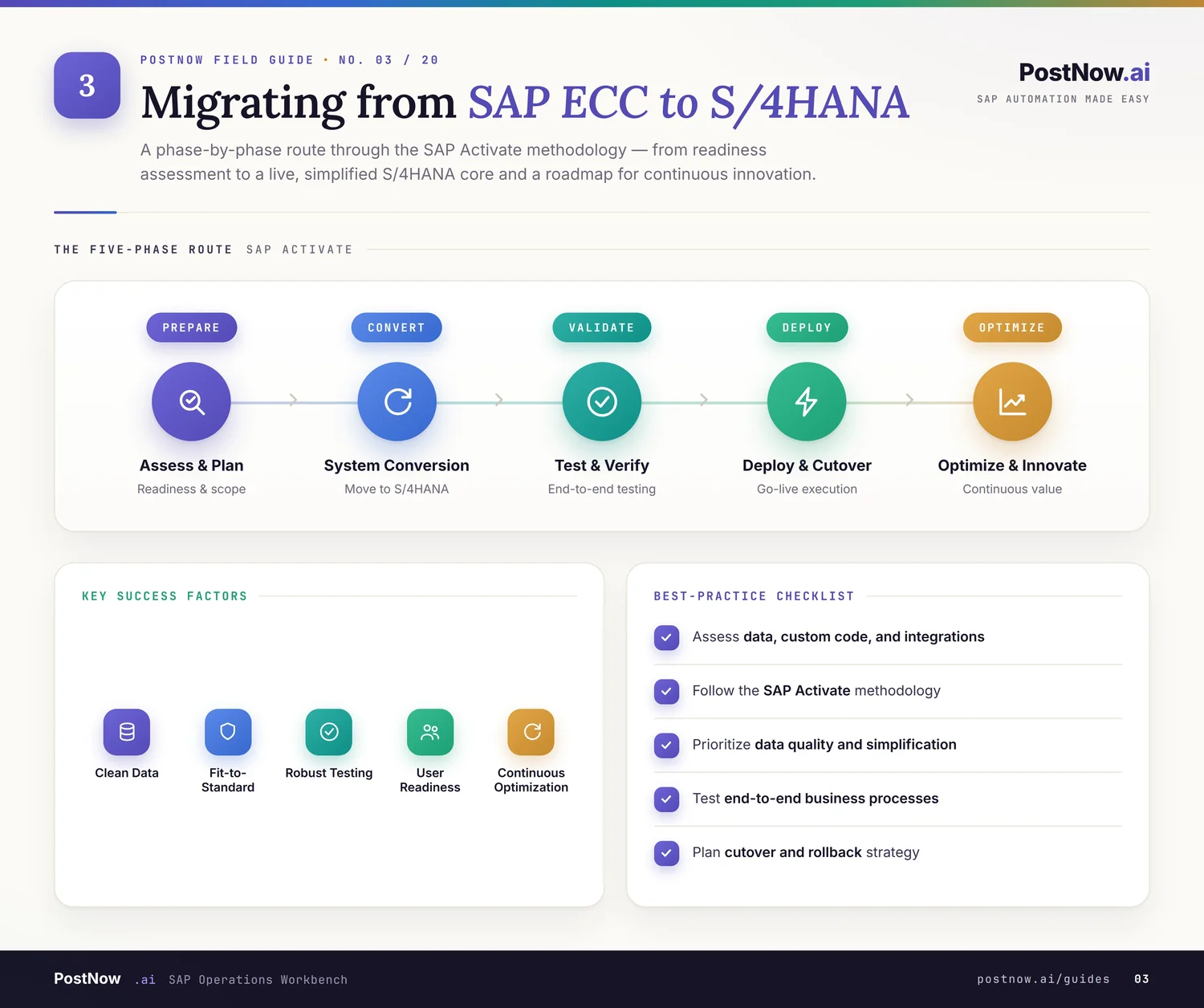
Most organizations face this move because mainstream support for older releases is finite and S/4HANA brings a modern data model. Whatever the trigger, the data in the old system has to be understood, cleaned, reshaped, and moved, and that work tends to be larger than first imagined.
This guide walks through the choices and steps involved: the approaches you can take, the Business Partner conversion that defines so many projects, how to get data ready, the simplifications to plan for, and the phases that lead to a stable go-live. For the broader discipline, the SAP data migration pillar sets the wider context.
It is written for the program managers, architects, and data teams who carry these projects, with the goal of making the road ahead clearer rather than simply listing terms.
It helps to set expectations at the outset. This is rarely a project a team can rush, because the data carries the history of every process the business has run for years. Respecting that reality, and budgeting time for it, is the first sign of a program that will land well.
A final framing before the detail: the prize is not only a working S/4HANA system, but a cleaner data foundation than the one you started with. Done well, the migration is the rare project that leaves the organization with better data than it had before, which pays dividends long after go-live.
What S/4HANA changes: the simplification list in plain terms
S/4HANA is not just ECC on a faster database. Several parts of the data model are simplified or reworked, and those changes shape the whole migration.
The most visible change is the move to a single, unified view of finance, where many older tables give way to one consolidated structure. Inventory and several other areas are simplified in similar ways. The effect is a cleaner model, but one that old mappings cannot simply be poured into.
The change that touches the most projects is the Business Partner. In ECC, customers and vendors are usually maintained as separate objects; in S/4HANA they are brought together under one entity that carries roles. Reconciling those two source worlds into one is a defining task of the move.
Each of these shifts has a knock-on effect on data. A change to how finance is stored changes how balances are reconciled, and a change to how partners are modeled changes how every customer and vendor record is prepared. Mapping the changes to their data consequences early is what prevents surprises later.
Understanding these shifts early matters because they drive the approach. A team that grasps how different the target is will plan for transformation, not just transfer.
A useful mental model is to think of the move as translation rather than copying. You are not carrying the old system across unchanged; you are expressing its meaning in a new language with a different grammar. Some phrases translate directly, others need rework, and a few have no equivalent and must be rethought.
It is also worth distinguishing simplification from loss. The new model removes redundancy, not meaning, and the information a business relies on is still there, often in a cleaner form. Framing simplification as tidying rather than stripping helps teams approach the mapping work with confidence instead of anxiety.
It is also worth noting that the target is a moving one in a good sense. S/4HANA continues to mature, and the model a team converts to today is more capable than the one early adopters faced. That maturity works in your favor, as long as the data you bring is clean enough to take advantage of it.
That dual benefit, a modern system and cleaner data, is worth holding onto when the work feels heavy. Every record cleansed for the conversion is a record that will behave better for years afterward.
The five things that go wrong in ECC to S/4HANA migrations
An ECC to S/4HANA move concentrates several hard problems into one program.
- Legacy data quality, where years of accumulated records carry gaps, duplicates, and retired codes.
- The Business Partner conversion, which surfaces every inconsistency between customer and vendor data.
- Simplification gaps, where structures that existed in ECC have no direct equivalent.
- Scope decisions, over how much history to bring and what to leave behind.
- Limited rehearsal time, as conversion and testing compete for the same calendar.
None of these is a reason to delay, but each is a reason to start the data work early. The single biggest predictor of a calm S/4HANA go-live is how clean the ECC data was before anyone touched the conversion.
There is a hopeful side to this list. Because the challenges are so well understood, the playbook for handling them is mature. None of them is a novel problem, which means a team can learn from the many programs that have gone before rather than discovering everything firsthand.
How to migrate from ECC to S/4HANA: approach, Business Partner, data
A successful move rests on three decisions handled well: which approach to take, how to convert the Business Partner, and how to prove the data is ready.
Choosing an approach
There are three broad routes, and the right one depends on the state of the current system and the appetite for change.
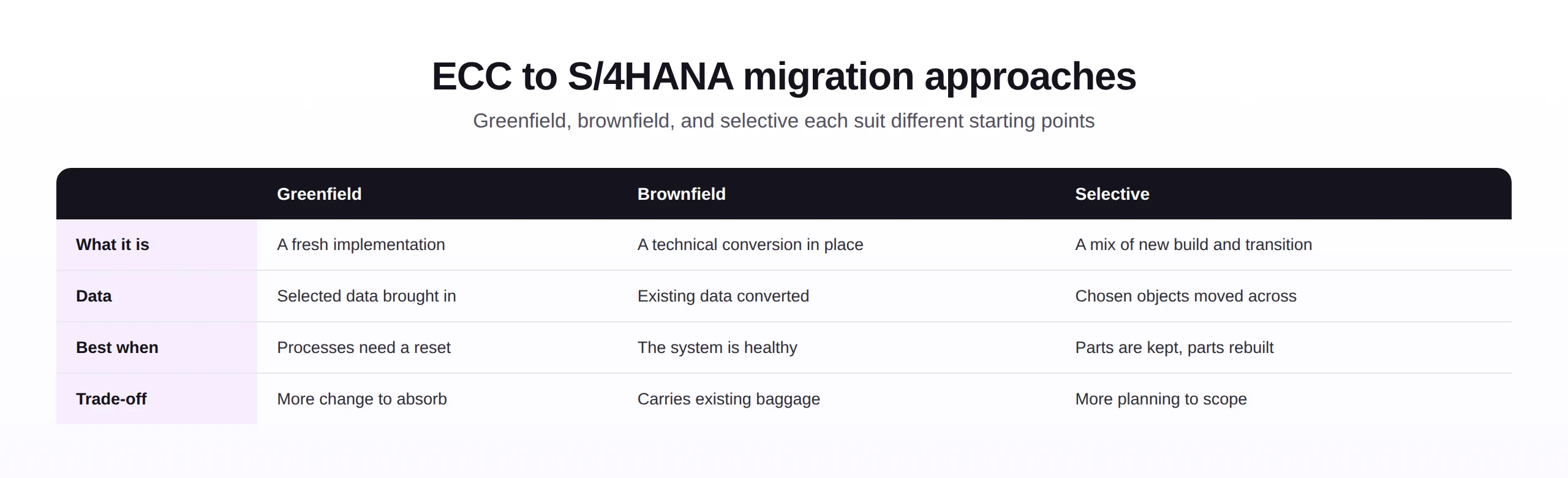
A greenfield approach rebuilds on S/4HANA and brings selected data across, which suits organizations that want to reset their processes. A brownfield approach converts the existing system in place, which is faster to plan but carries the current data and configuration with it. A selective route blends the two, keeping what works and rebuilding the rest, at the cost of more careful scoping.
One practical tip on choosing: let the condition of the data inform the decision, not just the appetite for process change. A landscape with clean, well-governed data has more freedom to convert in place, while one weighed down by years of data debt may find a fresh start easier than dragging old records forward.
The Business Partner conversion
Because S/4HANA unifies customers and vendors, the conversion is rarely a simple lift. Records that overlap have to be matched, duplicates resolved, and the right roles assigned, all while preserving the links that transactions depend on.
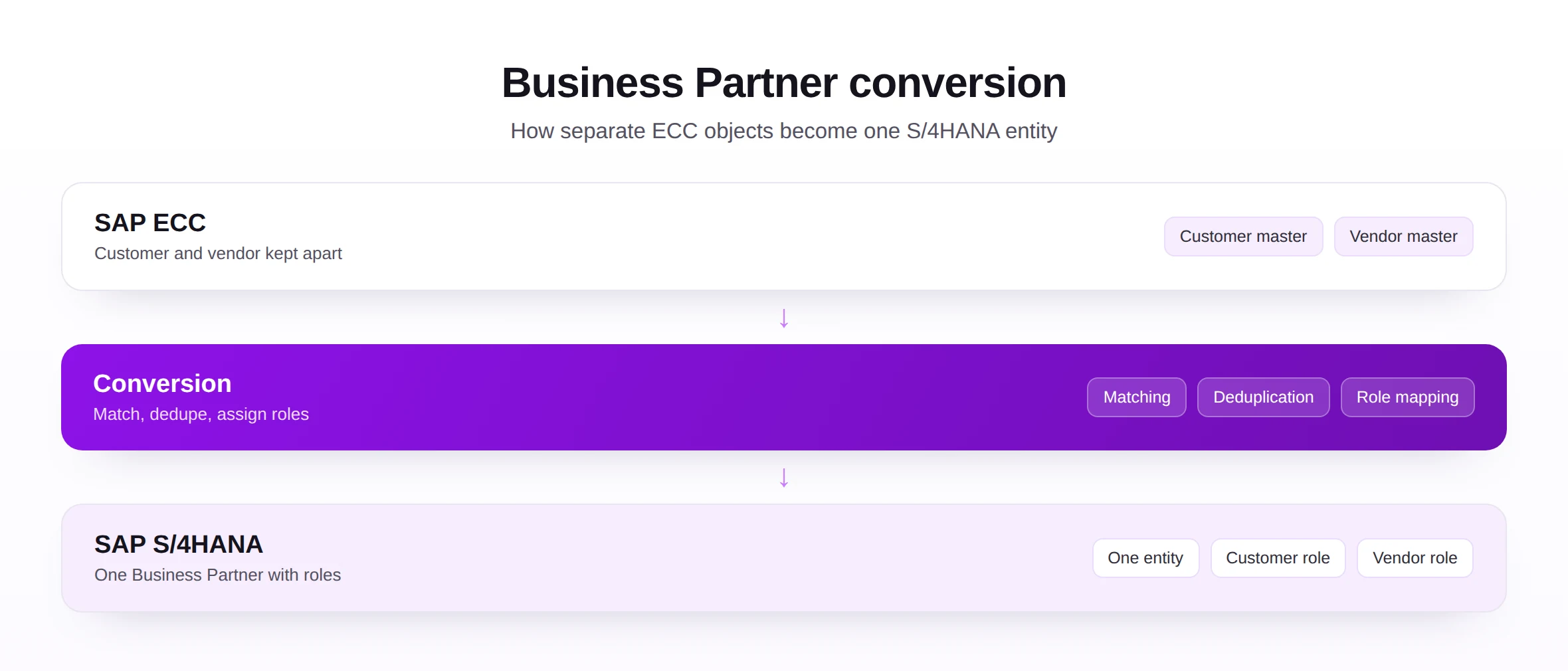
The work pays off well beyond the project, since a clean Business Partner foundation removes the duplication that plagued the two-object world. Treating it as a data exercise, supported by strong master data management, is what keeps it manageable. The Business Partner object is a natural place to apply repeatable, validated loads.
It is wise to begin the Business Partner analysis long before the formal conversion. Simply listing where the same organization appears as both a customer and a vendor, and where duplicates hide, gives the team a head start and turns the eventual conversion into a confirmation rather than a discovery.
The conversion is also the point where most LSMW objects from ECC stop working, because recordings of XD01 and XK01 have nothing to replay against. Plan the customer and vendor loads on the Business Partner from the start; the master data migration guide has the load order and the BAPIs.
Getting data ready
- Profile the ECC data to find the gaps, duplicates, and obsolete values that the conversion will expose.
- Cleanse at the source, so the improvements are permanent rather than redone at each trial.
- Standardize key master objects, including the vendor, customer, and material masters, before conversion.
- Anchor it all in master data governance, so standards and ownership are clear from the start.
Across all three decisions, the through-line is data readiness. The approach you can safely take, the smoothness of the Business Partner conversion, and the confidence of the cutover all rest on how clean and well understood the data is. Time spent here is never wasted; it simply moves the effort earlier, where it is cheaper.
For the load itself, the free SAP upload and migration templates cover 75 processes, each mapped to the SAP interface it posts through. Start with the SAP master data migration templates, since master data loads first and in a fixed dependency order.
If LSMW objects from ECC are part of the plan, check what happens to LSMW objects in S/4HANA before relying on them for the load.
ECC to S/4HANA migration steps, phase by phase
Whatever the approach, the work flows through a recognizable set of phases. Naming them keeps the program honest about what is done and what remains.
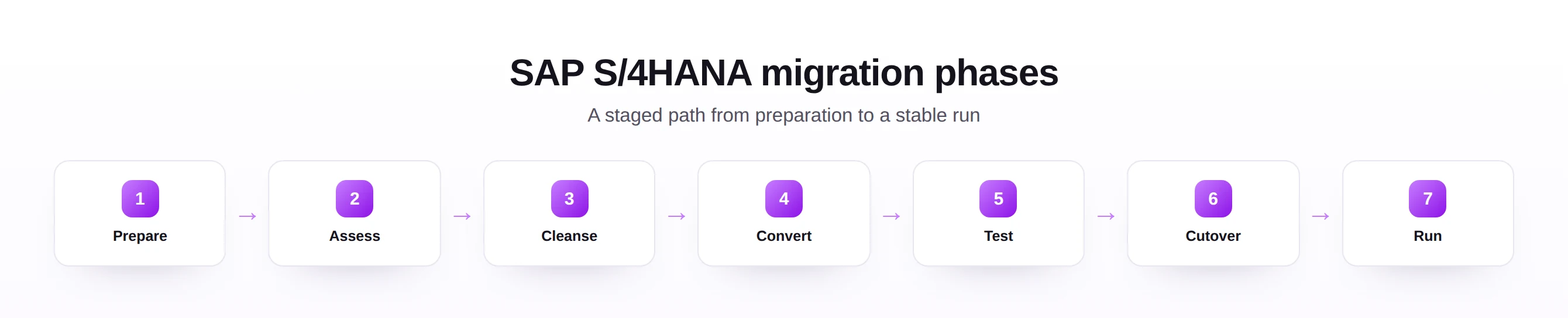
| Phase | What happens |
|---|---|
| Prepare | Agree the approach, scope, and target model. |
| Assess | Profile the source and quantify the data work ahead. |
| Cleanse | Fix and deduplicate records at the source. |
| Convert | Transform data to the new model, including the Business Partner. |
| Test | Run trial conversions and reconcile the results. |
| Cutover | Execute the live move in the planned window. |
| Run | Stabilize, support users, and monitor the new system. |
The phases overlap in practice, and assessment often reopens as testing reveals new quirks. The value of naming them is to ensure none is skipped when the schedule tightens.
One caution on the phases: progress through them is not always linear. A discovery during testing can send the team back to cleansing, and that is healthy, not a failure. The plan should expect these loops rather than treat them as slippage, so the schedule has room to absorb what trials reveal.
It also helps to keep the legacy system reachable for a while after go-live. Being able to look back at how a record appeared in ECC settles many questions quickly in the early days, and it provides a reference point for any reconciliation that needs a second look.
SAP ECC to S/4HANA migration tools: which tool for which data
The tooling question comes up in every migration and is usually answered too late. Four tools appear, and they were built for different points in the project.
SAP S/4HANA Migration Cockpit is SAP's tool for the initial data load into a new S/4HANA system, in a greenfield or selective transition. It ships with predefined migration objects for master data and open items, takes data from staging tables or a connected source system, and validates and simulates before it posts. The Migration Cockpit guide covers its objects, staging tables and load sequencing.
Software Update Manager with the Database Migration Option (SUM with DMO) is the tool for a brownfield system conversion: it converts the existing ECC system in place, database and application together, and no data is "loaded" in the migration sense. Data readiness for a conversion is about cleansing in ECC and completing the Business Partner synchronisation before the conversion runs.
LSMW is the tool ECC teams know, and it still opens in S/4HANA on-premise as restricted use. Objects built on the BAPI method carry over; objects built on recordings of transactions that changed in S/4HANA, above all XD01 and XK01, do not. The LSMW guide has the full status and the list of what breaks.
Excel based loading through standard BAPIs covers the loads the other tools were not designed for: corrections during mock loads, delta loads between the last mock and cutover, and every master data and document load after go-live, when the migration tooling has been handed back and the work has moved to finance and master data users. That is what PostNow.ai is built for, and the master data migration guide gives the load order and the BAPI for every object.
What those loads look like week by week is covered in the guide to loads after go-live.
| Data | Greenfield or selective | Brownfield conversion | After go-live |
|---|---|---|---|
| Master data | Migration Cockpit, in dependency order | Converted in place; Business Partner via CVI | Excel through BAPIs |
| Open items and balances | Migration Cockpit | Converted in place | Excel through BAPIs for corrections |
| Historical documents | Usually not migrated, or selective transition tooling | Converted in place | Not applicable |
| Configuration | Rebuilt or transported | Converted | Transports |
The three planning workbooks built for the Migration Cockpit guide, the object load sequence planner, the field mapping tracker and the cutover readiness checklist, apply to every approach and are free to download.

ECC to S/4HANA migration mistakes to avoid
The same missteps recur across S/4HANA programs, and all of them are avoidable.
Each has the same remedy: start the data work early, give the Business Partner the attention it deserves, revisit every mapping against the new model, and protect time for trial conversions. The technology rarely fails; preparation is what makes or breaks the move.
Read together, these mistakes share a root cause: underestimating the data. Whether it shows up as a late Business Partner conversion or reused mappings, the fix is the same shift in mindset, treating the migration as a data transformation that happens to involve a system change, rather than the reverse.
If there is one habit that prevents most of these mistakes, it is to make data quality visible from day one. When everyone can see the state of the source, the case for early cleansing makes itself, and the temptation to defer the hard work until later simply fades.
What changes next: RISE, clean core and the 2027 deadline
S/4HANA migration is steadily becoming more assisted, though the fundamentals of clean data and careful conversion remain.
- Assisted analysis, where tools highlight simplification impacts and data issues earlier.
- Smarter conversion, with more of the Business Partner matching suggested automatically.
- Cloud destinations, as more organizations target cloud editions of S/4HANA.
- Reusable accelerators, that shorten the build for common objects.
- Continuous readiness, treating data quality as an ongoing measure rather than a one-time check.
However the tooling evolves, the lesson holds: an S/4HANA migration succeeds on the quality of the data going in and the rigor of the reconciliation coming out.
For organizations still planning their move, the encouraging takeaway is that none of this requires waiting for better tools. The disciplines that matter most, profiling, cleansing, governing, and reconciling, are available today, and a team that masters them now will be ready to use whatever assistance arrives next.
Seen in the round, an ECC to S/4HANA move is less a leap than a series of deliberate, well rehearsed steps. Teams that treat it that way, with the data front and center, tend to look back on it as demanding but orderly, rather than the crisis it is sometimes feared to be.
Frequently asked questions
How do you load data into S/4HANA after go-live?
What is the difference between greenfield and brownfield SAP migration?
What is Business Partner conversion in S/4HANA?
How do you prepare data for an S/4HANA migration?
What are the phases of an ECC to S/4HANA migration?
How long does an SAP S/4HANA migration take?
What are the steps to migrate from SAP ECC to S/4HANA?
Which tools are used for SAP ECC to S/4HANA data migration?
What is the difference between a system conversion and a new implementation?
What happens to LSMW after migrating to S/4HANA?
Is there an Excel tool for loading data into S/4HANA?
How do I load customers and vendors into S/4HANA from Excel?
XD01 and XK01 do not carry over to S/4HANA, which is why the Business Partner load goes through the interface rather than the screens.